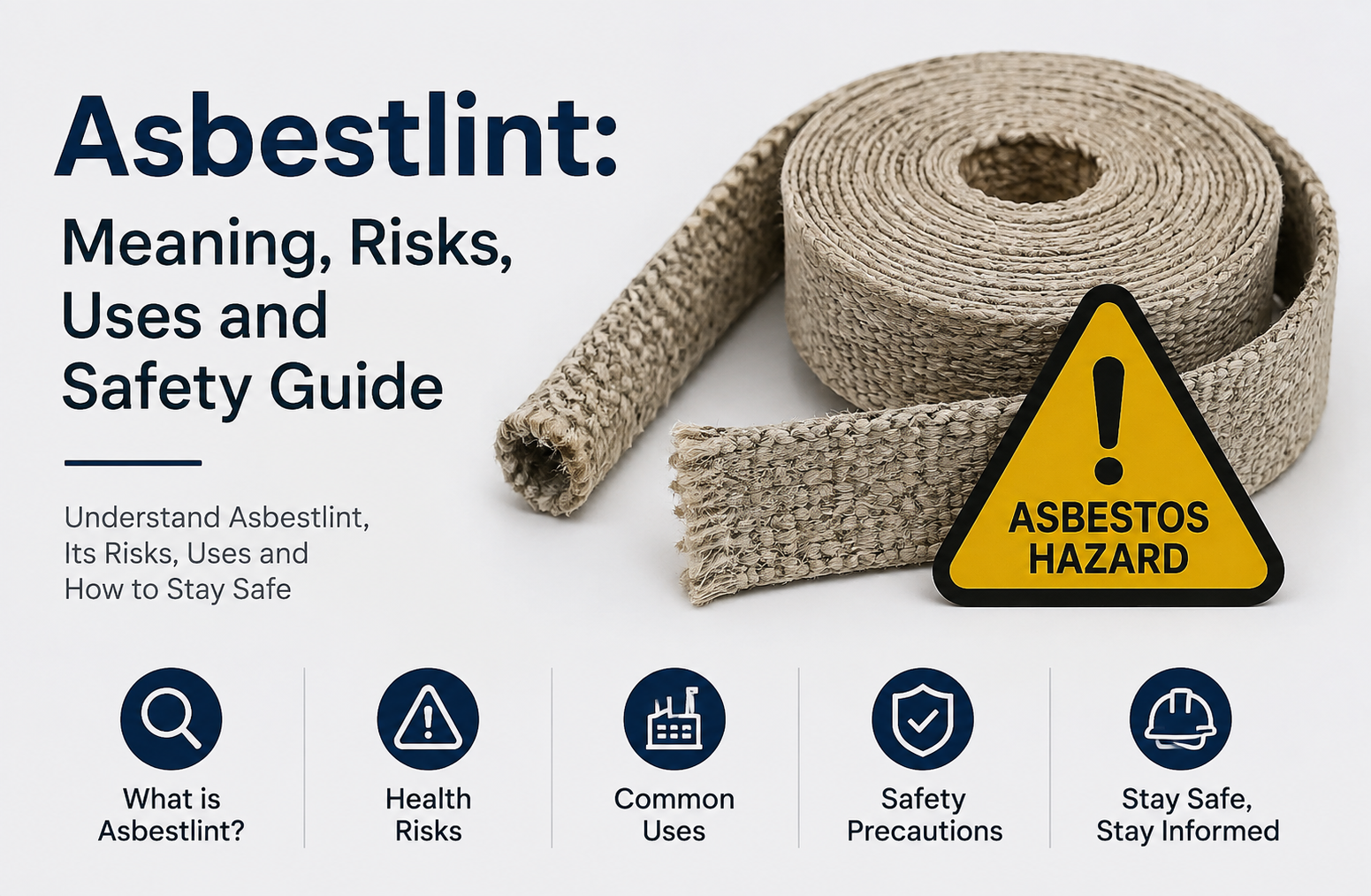
Asbestlint: Meaning, Risks, Uses and Safety Guide
Asbestlint is a term that can be confusing because it does not have one universally accepted technical definition. In many contexts, it is used to describe older asbestos-containing tape, woven strips, cloth, rope, sealing material, or similar flexible products. In other contexts, people use the word when discussing fine asbestos fibers or fibrous material released from deteriorating asbestos products. The important point is that the word itself does not prove what a material contains. If you have found an old fibrous strip, tape, or insulation material, the safest approach is to identify the actual material rather than relying on its appearance or name.
What Is Asbestlint?
Asbestlint generally refers to flexible or textile-like material associated with asbestos. Historically, asbestos fibers were incorporated into products such as tape, cloth, rope, packing and insulation because asbestos could tolerate high temperatures and resist wear.
The term is not a recognized scientific classification for a separate type of asbestos. This distinction matters because online discussions sometimes use the word in different ways.
For example, someone may describe a woven strip wrapped around an old pipe as asbestlint. Another person may use the same term when talking about loose asbestos fibers or dusty material produced when an asbestos-containing product deteriorates.
Therefore, the most useful question is not simply, “Is this asbestlint?” The better question is:
Could this material contain asbestos, and has it been damaged or disturbed?
That question leads to the practical safety issue.
Asbestos is a group of naturally occurring mineral fibers. It was widely used because it provided useful properties including heat resistance, durability and insulation. Older asbestos-containing materials can still be present in buildings and equipment today.
According to Dutch government information, asbestos may occur in many products manufactured before 1994, and asbestos can be difficult to identify by sight alone. Laboratory examination is used when the material needs to be confirmed. (Rijksoverheid)
Asbestlint and Asbestos Are Not the Same Thing
One of the most important points to understand is that asbestlint should not be treated as the name of a unique mineral.
Asbestos is the hazardous mineral material.
Asbestlint is an informal term that may describe an asbestos-containing flexible product or, depending on the source, asbestos-related fibrous material.
This distinction prevents a common mistake. A person may find a strip of old tape and assume that its name tells them what it is made from. It does not.
Two pieces of material can look almost identical while having completely different compositions.
For example, an old woven strip could potentially be:
- Cotton
- Fiberglass
- Mineral fiber
- Synthetic material
- An asbestos-containing textile
- Another historical insulation product
Visual appearance alone cannot reliably establish the presence or absence of asbestos.
This is particularly important during renovation. Cutting, drilling, sanding, scraping, breaking or aggressively cleaning an unknown old material can change a relatively contained material into a potential airborne exposure source.
Why Was Asbestlint Used?
Older asbestos-containing flexible products were attractive to manufacturers and workers because asbestos had several useful physical characteristics.
Heat resistance
Asbestos could tolerate high temperatures, making asbestos-containing textiles useful around equipment exposed to heat.
This helped make asbestos products attractive for applications involving:
- Boilers
- Furnaces
- Heating equipment
- Pipes
- Industrial machinery
- Hot surfaces
- Certain sealing applications
Fire resistance
Asbestos was also valued for its resistance to fire and heat.
Historically, this made asbestos-based materials useful in situations where ordinary fabric or other materials could deteriorate rapidly.
Flexibility
When asbestos fibers were woven or incorporated into textile products, the resulting material could be flexible.
That made tape, rope, cloth and packing useful for irregular surfaces and joints.
Durability
Asbestos was resistant to wear and could remain in place for many years.
Ironically, that durability is one reason asbestos-containing products can still be encountered in older buildings and equipment.
The historical usefulness of asbestos should not be confused with its modern safety profile. Its health hazards became increasingly clear as evidence accumulated about diseases caused by inhaling asbestos fibers.
Where Might Asbestos-Containing Flexible Material Be Found?
There is no single location where this type of material occurs.
The possibility depends heavily on the age, construction history and previous modifications of a building or piece of equipment.
Potential historical applications include:
Pipes and heating systems
Flexible asbestos-containing materials were used in some older heating and insulation applications.
A strip that looks like fabric or tape around a pipe should not automatically be assumed to be harmless simply because it appears dry or old.
Boilers and furnaces
High-temperature equipment historically used asbestos-containing materials because of asbestos’s thermal properties.
Older boiler rooms can therefore deserve particular attention during maintenance or renovation.
Ducts and ventilation equipment
Some historical sealing and insulation products incorporated asbestos.
If an old duct connection contains unusual fibrous tape or insulation, disturbing it before determining its composition can create an unnecessary risk.
Industrial equipment
Factories and workshops historically used asbestos in numerous applications.
Equipment that has been repeatedly repaired over decades may contain materials from different periods, making visual identification even more difficult.
Seals, gaskets and packing
Asbestos fibers were also incorporated into certain sealing products.
These applications could involve small amounts of material, but the small size of a component does not automatically make asbestos harmless if it is disturbed.
Older household equipment
Some older appliances and heating products used asbestos-containing components for heat protection.
This is another reason why dismantling very old equipment without knowing its construction history can be problematic.
Is Asbestlint Dangerous?
If the term is being used to describe an asbestos-containing material, the health concern comes primarily from asbestos fibers that can become airborne and then be inhaled.
Intact asbestos-containing material is not automatically equivalent to an active airborne exposure.
The condition of the material matters.
A firmly bound material that remains intact may behave very differently from a damaged, crumbling or easily disturbed material.
The risk can increase when asbestos-containing material is:
- Broken
- Cut
- Drilled
- Sanded
- Scraped
- Crushed
- Torn
- Mechanically disturbed
- Damaged by fire or deterioration
The Dutch Arboportaal explains that inhaling asbestos fibers can cause serious diseases, including lung cancer, mesothelioma and asbestosis. It also notes that health effects can take many years to become apparent. (Arboportaal)
This long latency period is one reason asbestos safety should be taken seriously even when a person feels completely healthy after a possible exposure.
Why Airborne Fibers Are the Main Concern
Asbestos is dangerous primarily because microscopic fibers can enter the respiratory system.
A large piece of asbestos-containing material sitting undisturbed is not the same situation as material being aggressively cut or broken.
Consider two different scenarios.
In the first, an old material remains intact behind an enclosure and nobody touches it.
In the second, someone uses a power tool to cut through the material during renovation.
The physical material may be the same, but the potential for fiber release can be very different.
This is why professional asbestos management focuses heavily on preventing fiber release rather than simply removing anything that looks old.
Can You Identify Asbestlint by Looking at It?
Usually, you should not rely on appearance.
This is one of the most important practical lessons for homeowners and renovators.
Asbestos-containing materials can resemble ordinary building products. A fibrous strip may look like cloth, rope, paper, insulation or modern synthetic tape.
Likewise, a material that looks suspicious may turn out to contain no asbestos.
The Dutch government specifically warns that asbestos can be difficult to recognize and states that laboratory testing can be used when identification is necessary. (Rijksoverheid)
Things that can increase suspicion
Certain circumstances may justify greater caution, such as:
- A building or installation with a significant historical age
- Unusual fibrous insulation
- Old pipe or heating insulation
- Unknown material discovered during renovation
- Deteriorating textile-like insulation
- Historical industrial equipment
- Material with no identifiable modern product label
- Material installed before modern asbestos restrictions
None of these characteristics proves that asbestos is present.
They simply provide a reason not to disturb the material until its status is understood.
Why Age Matters
The age of a building can provide useful context, but it should not be treated as a definitive asbestos test.
Asbestos was widely used during the twentieth century.
In the Netherlands, asbestos was used extensively in buildings and other applications, while the use of asbestos in new products was prohibited from 1993. The government notes that buildings constructed before the relevant restrictions can still contain asbestos-containing materials. (Arboportaal)
This creates a practical rule:
An older building does not mean asbestos is definitely present, but an unknown material in an older building deserves appropriate caution.
Construction date should therefore be treated as one part of an assessment rather than proof.
What Should You Do If You Find Suspected Asbestlint?
The safest response is to avoid turning an identification problem into an exposure problem.
1. Stop disturbing the material
If you are working on a renovation and discover an unfamiliar fibrous material, stop the activity around it.
Do not continue cutting, drilling, sanding or pulling it apart simply to see what is underneath.
2. Keep people away from the immediate area
Children, visitors and people who are not involved in the assessment should not handle the material.
If the material is damaged or shedding debris, unnecessary movement around the area should also be minimized.
3. Do not sweep or aggressively clean suspected asbestos debris
Ordinary cleaning methods can potentially spread contaminated dust.
Do not assume that a household vacuum cleaner is an appropriate solution for suspected asbestos contamination.
4. Do not take a sample casually
It may be tempting to cut off a small piece and send it to a laboratory.
The problem is that collecting a sample can itself disturb the material.
Where asbestos is reasonably suspected, professional assessment is the safer approach.
5. Obtain appropriate professional advice
If the material needs to be identified or removed, use a qualified professional who understands asbestos assessment and applicable local requirements.
The exact legal process depends on the country, type of building, material and planned work.
Asbestlint and Renovation Work
Renovation is one of the situations where asbestos risks can become particularly important.
A material that has remained untouched for decades may be disturbed within minutes during remodeling.
Common renovation activities include:
- Removing walls
- Replacing ceilings
- Opening service areas
- Replacing heating systems
- Modifying pipes
- Removing old insulation
- Replacing flooring
- Repairing ventilation systems
- Demolishing structures
The danger is not necessarily obvious at the start of the project.
A contractor may begin with a simple task and discover unexpected old materials once surfaces are opened.
That is why asbestos assessment should happen before destructive work where asbestos is reasonably possible.
In the Netherlands, work involving buildings or objects from before 1994 can require an asbestos inventory, and the applicable procedure depends on the risk classification and nature of the work. (Arboportaal)
Why DIY Removal Can Be a Bad Idea
The biggest mistake is to assume that removing a small amount of suspected asbestos is automatically safe.
Size does not determine whether professional controls are necessary.
A small strip can still contain asbestos fibers.
More importantly, removing a material incorrectly can create airborne contamination that is more difficult to control than the original intact material.
DIY work can also create secondary contamination.
Fibers or contaminated dust can potentially move onto:
- Clothing
- Shoes
- Tools
- Nearby surfaces
- Furniture
- Other rooms
This is why professional asbestos work involves controlled procedures rather than simply putting the material into a bag.
What Professional Asbestos Assessment Involves
The exact process varies depending on the situation, but professional assessment typically focuses on several questions.
What is the material?
The first question is whether the material actually contains asbestos.
Where is it located?
The location determines how likely the material is to be disturbed and who may be exposed.
What condition is it in?
An intact material may present a different management issue from damaged or deteriorating material.
Will future work disturb it?
A material that can safely remain undisturbed may need a different approach from one directly affected by renovation.
What does local regulation require?
Asbestos regulations differ by jurisdiction and can change over time.
For work in the Netherlands, the current regulatory framework includes specific requirements for asbestos inventories, risk classes, notifications and certified removal in situations where the applicable rules require it. (Arboportaal)
Asbestlint and the Difference Between Identification and Removal
These are two separate tasks.
Identification answers:
What is this material?
Risk assessment answers:
What condition is it in, and what could happen if it remains?
Removal planning answers:
If it must be removed, how can the work be performed safely and legally?
Confusing these stages can lead to poor decisions.
For example, finding a suspicious strip does not automatically mean that it should immediately be ripped out.
Sometimes the safer initial action is to leave it alone while arranging proper assessment.
Does Asbestlint Always Need to Be Removed?
No.
The presence of asbestos does not automatically mean every piece must immediately be removed.
The appropriate management approach depends on factors such as:
- Material condition
- Location
- Accessibility
- Likelihood of disturbance
- Planned renovation
- Potential exposure
- Applicable regulations
The Dutch government states that some asbestos-containing materials can remain in place when they are intact and do not create a situation in which fibers can be released. It also emphasizes that damaged material can require removal and that professional involvement may be necessary. (Rijksoverheid)
This is an important distinction.
“Contains asbestos” and “must immediately be removed” are not always the same statement.
Encapsulation Versus Removal
In asbestos management, there can be situations where the preferred strategy is to control the material rather than immediately remove it.
Encapsulation generally means applying an appropriate system to help contain the asbestos material and prevent fiber release.
Removal means taking the asbestos-containing material out under controlled conditions.
Neither option should be selected simply because it sounds easier.
The correct approach depends on the material, condition, location and applicable requirements.
A professional assessment should determine the appropriate management strategy.
What Happens After Asbestos Removal?
Professional removal does not necessarily end when the material has been taken away.
The work area may need appropriate cleaning, waste handling and final assessment.
In the Netherlands, asbestos removal procedures can include a final assessment by an appropriately authorized laboratory before an area is released for further work. (Arboportaal)
This matters because the goal is not merely to make the visible material disappear.
The objective is to control the potential exposure risk throughout the process.
Asbestlint in Older Dutch Buildings
The Dutch context is particularly relevant because asbestos was widely used in construction and industrial applications during the twentieth century.
The Dutch government identifies numerous possible asbestos applications, including asbestos cement, insulation, asbestos paper or cardboard, asbestos textiles and asbestos-containing gaskets. (Arboportaal)
This history explains why people renovating older properties can still encounter unfamiliar fibrous materials.
It also explains why assumptions based only on modern construction materials can be misleading.
A material that looks unusual may be a historical product that is no longer commonly manufactured.
Current Asbestos Rules in the Netherlands
Anyone dealing with suspected asbestos in the Netherlands should be aware that the regulatory framework is evolving.
Current Dutch workplace rules distinguish between different asbestos risk classes, and certain work must be performed by certified companies and workers.
Arboportaal currently states that work involving asbestos in risk class 2 or 2A must be performed by a certified removal company with appropriately certified workers. It also describes notification and final assessment requirements. (Arboportaal)
There are also planned changes arising from the strengthened European Asbestos Directive.
According to Arboportaal, new Dutch asbestos rules are expected from 2027, including a new licensing framework for asbestos removal activities. (Arboportaal)
Because regulations can change, property owners and contractors should check the rules applicable at the time work is planned rather than relying on an old checklist.
Common Mistakes People Make
Mistake 1: Assuming old fabric is harmless
Old textile-looking material can have many possible compositions.
Do not assume it is cotton simply because it looks like cloth.
Mistake 2: Assuming white material is asbestos
Color is not a reliable identification method.
Mistake 3: Pulling the material off a pipe
Removing an unknown material without assessment can create unnecessary disturbance.
Mistake 4: Using a normal vacuum cleaner
Ordinary household cleaning equipment should not be treated as an asbestos remediation system.
Mistake 5: Relying on internet photographs
Photographs can help with awareness, but they cannot reliably establish the composition of an unknown material.
Mistake 6: Ignoring damaged material
If a suspicious material is visibly deteriorating, treat the situation with greater caution and seek appropriate professional advice.
Mistake 7: Assuming a small quantity is harmless
The amount and physical condition of material are important, but “small” does not mean “safe.”
A Practical Decision-Making Checklist
If you encounter suspected asbestos-containing tape, rope, cloth or fibrous insulation, use this simple sequence:
- Stop disturbing it.
- Do not cut, sand, drill or tear it.
- Keep unnecessary people away.
- Avoid creating dust.
- Do not rely on appearance for identification.
- Arrange appropriate professional assessment where asbestos is reasonably suspected.
- Follow the applicable local asbestos requirements.
- If removal is required, use the appropriately qualified or certified professionals required for the job.
- Do not resume renovation work in the affected area until the situation has been properly assessed.
This approach is much safer than trying to solve the problem by trial and error.
Health Effects Associated With Asbestos Exposure
Asbestos exposure is associated with serious diseases.
The established health concerns include:
- Mesothelioma
- Lung cancer
- Asbestosis
- Other asbestos-related cancers and diseases
The Dutch government notes that asbestos-related health problems can take decades to appear. (Rijksoverheid)
This is one reason asbestos safety should focus on preventing unnecessary exposure rather than waiting for symptoms.
A person cannot determine whether a material was asbestos simply by whether they feel well after handling it.
Health effects are not an immediate identification tool.
What If You Already Disturbed a Suspected Material?
Do not panic, but do take the situation seriously.
If you accidentally disturbed an unknown material that could contain asbestos, stop the work and avoid further disturbance.
The appropriate next step depends on what happened, the material involved and the circumstances of the potential exposure.
Avoid sweeping up dust or continuing renovation simply because the visible debris appears small.
If there is significant concern about possible exposure, professional environmental or occupational health advice can help determine what should happen next.
The key principle is simple:
Do not turn a possible exposure into repeated exposure.
Why Accurate Information Matters
The term asbestlint illustrates a broader problem with online asbestos information.
Unusual terminology can produce contradictory explanations.
Some sources use the term for asbestos tape. Others use it for fibers or contamination. Some even use it for asbestos warning tape, which is a completely different product from asbestos-containing material.
That is why reliable asbestos guidance should focus on the underlying material and exposure risk instead of treating every use of the keyword as a precise technical definition.
The safest interpretation is to regard the term as context-dependent.
If someone has discovered a material described as asbestlint, the material itself should be assessed.
Asbestlint vs Modern Non-Asbestos Materials
Modern products can look very similar to historical asbestos materials.
For example, modern fiberglass tape may resemble older woven insulation products.
Likewise, modern high-temperature sealing products may look similar to historical asbestos-containing rope or packing.
This creates a serious identification challenge for anyone working without specialist knowledge.
The fact that a material looks modern does not prove its composition.
The fact that it looks old does not prove asbestos either.
Testing and professional assessment are therefore more reliable than visual guesses.
Frequently Asked Questions
What does asbestlint mean?
Asbestlint is an informal term that can refer to asbestos-containing tape, cloth, rope, strips or other flexible fibrous materials. Its meaning varies by context and it is not a standardized scientific classification.
Is asbestlint dangerous?
If the term refers to asbestos-containing material, it can present a health risk when asbestos fibers become airborne and are inhaled. The risk depends on the material, its condition and the circumstances of exposure.
Can you identify asbestlint by appearance?
No. Asbestos-containing materials can resemble ordinary fabric, insulation, rope, paper or fiberglass. Laboratory testing or appropriate professional assessment may be needed for reliable identification.
Should suspected asbestos tape be removed immediately?
Not necessarily. Removing asbestos can itself release fibers if performed incorrectly. The material should be assessed first, and the appropriate management strategy should follow the applicable professional and legal requirements.
Can I remove suspected asbestos myself?
Whether a person can legally perform particular asbestos work depends on the country, material and circumstances. In the Netherlands, specific asbestos work requires certified professionals, particularly where the applicable risk classification requires it. (Arboportaal)
What should I do if I find suspected asbestos during renovation?
Stop disturbing the material, prevent unnecessary access to the area, avoid creating dust and arrange appropriate professional assessment before continuing work.
Conclusion
Asbestlint is a confusing term because it is used in different ways. In many contexts, it refers to older asbestos-containing tape, cloth, rope, packing or other flexible fibrous products. In other discussions, it is used more broadly for asbestos-related fibers or fibrous contamination.
The most important lesson is that the name and appearance of an unknown material are not enough to establish what it contains.
Asbestos was historically valued for heat resistance, durability and insulation, but inhalation of asbestos fibers can cause serious diseases, including mesothelioma, lung cancer and asbestosis. The long delay between exposure and disease makes prevention especially important.
If you encounter an old fibrous material during renovation, maintenance or demolition, the safest approach is straightforward: do not disturb it unnecessarily, do not rely on visual identification, and obtain appropriate professional assessment when asbestos is reasonably suspected.
For property owners and renovators, this approach is more useful than trying to identify a suspicious material through photographs or assumptions. The goal is not simply to determine whether something “looks like” asbestos. The goal is to understand what the material is, whether it can release fibers, and what the safest and legally appropriate next step is.