Nahttypen: A Complete Guide to Seam Types in Sewing
Nahttypen are one of the most important foundations of sewing and garment construction. The right seam affects how a garment looks, how comfortable it feels, how long it lasts, and how well it performs after repeated washing and use. Although seams can appear simple from the outside, professional garment production depends on choosing the correct construction method for each fabric, garment area, and performance requirement.
A seam is more than a line joining two pieces of fabric. It is a structural part of a garment. It must handle movement, tension, friction, washing, pressing, and sometimes exposure to moisture or heat. A seam that looks attractive but cannot withstand normal use is not a successful construction.
Understanding different seam types is therefore useful for beginners, home sewers, fashion students, tailors, quality inspectors, and garment manufacturing professionals. It also makes it easier to identify construction problems and understand why one seam is preferred over another.
This guide explains the major seam constructions, where they are used, their advantages and limitations, and how to select the appropriate option for different fabrics and garments.
What Are Nahttypen?
Nahttypen refers to the different types of seams and seam constructions used to join fabric pieces together. In practical sewing, a seam is created when two or more fabric sections are joined along a defined line using thread, stitching, or another construction technique.
Different constructions produce different results.
For example, a simple plain seam may be appropriate for a cotton shirt, while a flat-felled seam may be better for denim trousers. A French seam can provide a neat finish on lightweight fabric, whereas an overlock seam can efficiently finish raw edges in mass garment production.
The important point is that there is no single seam that works best for every garment.
The selection depends on several factors:
- Fabric thickness
- Fabric structure
- Stretch and recovery
- Garment design
- Seam location
- Required strength
- Desired appearance
- Production speed
- Washing requirements
- Comfort requirements
- Risk of fraying
- Cost and manufacturing method
A professional approach considers all of these factors rather than choosing a seam simply because it is familiar.
Why Seam Selection Matters
Seam selection directly affects garment quality.
A poorly selected seam can create puckering, bulk, discomfort, fraying, broken stitches, or seam failure. In production environments, these problems can lead to rejected garments and increased rework.
A suitable seam, on the other hand, can provide:
Better Durability
A strong construction helps the garment tolerate repeated movement and washing.
Improved Appearance
Some seam constructions hide raw edges and create a cleaner finish.
Greater Comfort
Seams placed against the skin need to minimize excessive bulk, rough edges, and irritation.
Better Fit
The construction method can affect how fabric behaves around curves and movement areas.
Easier Production
Factories often select seam constructions that provide an appropriate balance between quality, speed, and cost.
Better Fabric Performance
Stretch fabrics, delicate fabrics, and heavy fabrics behave differently. The seam needs to work with the material rather than against it.
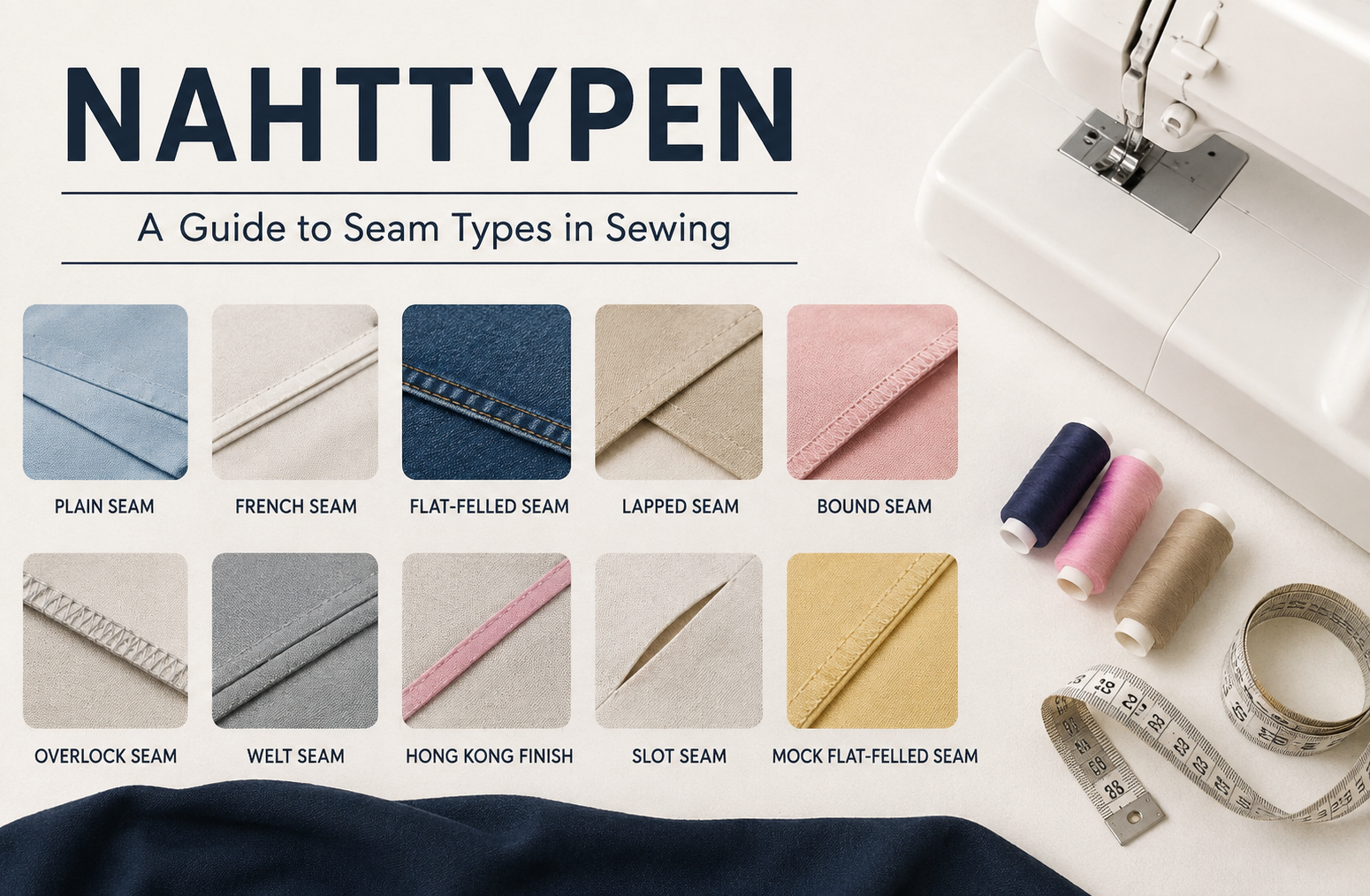
Main Nahttypen Used in Garment Construction
There are many seam variations, but several basic constructions appear repeatedly in clothing production.
The following types are especially important:
- Plain seam
- French seam
- Flat-felled seam
- Lapped seam
- Bound seam
- Overlock or serged seam
- Welt seam
- Hong Kong finish
- Slot seam
- Mock flat-felled seam
The exact terminology can vary between sewing references, manufacturers, and regions. Some constructions also overlap in appearance or function.
1. Plain Seam
The plain seam is one of the most basic and widely used seam constructions.
Two fabric pieces are placed with their right sides facing each other. They are stitched along the seam line, and the fabric is then opened or pressed according to the design.
This construction is common because it is simple, versatile, and efficient.
Where Is a Plain Seam Used?
Plain seams can be found in many garments, including:
- Shirts
- Dresses
- Skirts
- Trousers
- Jackets
- Home textiles
- Casual clothing
The raw edges may require additional finishing if the fabric frays.
Advantages
The main benefits include:
- Simple construction
- Fast sewing
- Easy pressing
- Suitable for many fabrics
- Easy alteration
- Low production complexity
Limitations
A basic plain seam leaves raw seam allowances unless they are finished separately.
On fabrics that unravel easily, an unfinished seam allowance can deteriorate over time.
The seam may also be unsuitable when a very clean enclosed interior is required.
2. French Seam
A French seam is a particularly useful construction for lightweight and delicate fabrics.
Instead of leaving the raw edges exposed, the seam encloses them inside the construction. This produces a clean interior finish.
The technique requires careful stitching and pressing because the seam is constructed in stages.
Where Is It Commonly Used?
French seams are often suitable for:
- Chiffon
- Silk
- Lightweight cotton
- Fine synthetic fabrics
- Delicate blouses
- Lightweight dresses
- Lingerie-style garments
Benefits of a French Seam
The most important advantage is its neat interior appearance.
Other benefits include:
- Raw edges are enclosed
- Reduced fraying
- Clean appearance
- Suitable for lightweight fabrics
- No separate overlocking is necessarily required
Limitations
French seams create additional layers of fabric.
That makes them less suitable for heavy materials because the finished seam can become unnecessarily bulky.
They also require more sewing time than a basic plain seam.
3. Flat-Felled Seam
The flat-felled seam is known for its strength and clean appearance.
The raw edges are enclosed within the seam construction, creating a durable finish. It is especially associated with garments that experience considerable wear.
Denim jeans are a familiar example.
Common Applications
Flat-felled seams are frequently associated with:
- Jeans
- Workwear
- Shirts
- Uniforms
- Outdoor garments
- Heavy cotton clothing
Why Is It Strong?
The construction distributes stress across multiple layers of fabric and stitching.
The enclosed edges also reduce exposure to abrasion.
This makes the technique useful when durability is more important than minimizing seam bulk.
Main Advantages
- Strong construction
- Durable finish
- Clean interior
- Raw edges enclosed
- Good resistance to wear
Limitations
It can become bulky with thick materials.
It also requires accurate sewing because several layers must be aligned correctly.
4. Lapped Seam
In a lapped seam, one fabric edge overlaps another rather than joining two edges in a traditional edge-to-edge arrangement.
The overlapping area is then secured with stitching.
This construction can be useful when strength, appearance, or design requires overlapping fabric sections.
Applications
Lapped constructions can appear in:
- Leather garments
- Heavy fabrics
- Sportswear
- Workwear
- Decorative garment details
- Certain traditional garment constructions
The exact application depends on the material and design.
5. Bound Seam
A bound seam uses a separate strip of fabric or binding material to cover the seam allowance.
The binding wraps around the raw edge and creates a finished appearance.
This technique can be especially useful when the inside of a garment is visible or when the designer wants a decorative finish.
Where Can It Be Used?
Bound seams are useful in:
- Jackets
- Coats
- Unlined garments
- Decorative interiors
- Lightweight outerwear
- Tailored clothing
Binding can be made from matching fabric or a contrasting material.
Advantages
- Attractive interior
- Raw edges covered
- Decorative possibilities
- Professional appearance
Limitations
The construction takes additional time and material.
It can also create extra bulk if the binding is not appropriate for the fabric weight.
6. Overlock or Serged Seam
Overlock construction is extremely important in modern garment manufacturing.
An overlock machine trims the fabric edge while simultaneously securing it with thread. Depending on the machine setup, it can perform edge finishing and seam construction in one operation.
This makes overlock machines highly useful for efficient production.
Why Is Overlocking Popular?
It offers several practical benefits:
- Fast operation
- Edge finishing
- Reduced fraying
- Efficient production
- Suitable for many knitted fabrics
- Professional interior appearance
Overlock machines are especially common in factories producing T-shirts, sportswear, casual clothing, and other mass-produced garments.
Overlocking and Stretch Fabrics
Certain overlock stitch configurations can accommodate fabric movement better than a conventional straight stitch.
However, stitch selection still matters. A seam can fail if the thread, needle, stitch density, machine tension, or construction is unsuitable for the fabric.
7. Welt Seam
A welt seam is created with a raised or folded appearance that can provide both structural and decorative value.
It is associated with tailored garments and certain decorative garment constructions.
The technique requires accurate control because the visible welt must remain consistent along the seam.
Common Uses
Welt-style constructions can be found in:
- Jackets
- Coats
- Tailored garments
- Decorative panels
- Structured clothing
Its value is often as much visual as functional.
8. Hong Kong Seam Finish
The Hong Kong finish uses bias-cut fabric to cover the raw seam allowance.
It is often associated with high-quality tailoring and unlined garments because it provides a refined interior appearance.
A contrasting binding can also create a deliberate design detail.
Benefits
- Premium interior appearance
- Raw edges covered
- Useful for unlined garments
- Decorative potential
- Suitable for tailored construction
Limitations
It requires additional fabric and labor.
It is therefore not always the most economical choice for basic mass-market garments.
9. Slot Seam
A slot seam creates a visible gap or design separation between fabric sections while maintaining structural stitching.
It is often selected for decorative purposes.
The technique can create strong visual lines on garments and may be used to highlight panels or contrasting materials.
Applications
Slot seams can be considered for:
- Fashion garments
- Decorative panels
- Sportswear details
- Contrasting fabric designs
- Structured garments
The final appearance depends heavily on accurate pressing and stitching.
10. Mock Flat-Felled Seam
A mock flat-felled seam is designed to resemble a true flat-felled seam while using a different construction method.
It can provide a similar visual effect with potentially different production requirements.
This type of approach can be useful in manufacturing when appearance needs to be maintained while reducing construction complexity.
Nahttypen for Different Fabrics
Choosing a seam based only on appearance is a common mistake.
Fabric behavior should be one of the first considerations.
Lightweight Fabrics
Light fabrics require constructions that do not create excessive bulk.
Suitable choices can include:
- French seams
- Fine plain seams
- Narrow finished seams
For delicate materials, aggressive handling can cause distortion or damage.
Medium-Weight Woven Fabrics
Medium-weight cotton and similar woven fabrics are highly versatile.
They can accommodate:
- Plain seams
- Bound finishes
- Overlocked seams
- Decorative constructions
- Certain felled seams
The best choice depends on the garment.
Heavy Fabrics
Heavy materials need construction methods capable of handling greater thickness and mechanical stress.
Examples include:
- Denim
- Heavy canvas
- Workwear fabrics
- Thick twill
Flat-felled or other reinforced constructions may be appropriate.
However, machine capability must also be considered. A seam that works theoretically may not be practical if the machine cannot handle the fabric thickness consistently.
Knitted Fabrics
Knits behave differently from woven fabrics because they can stretch.
A rigid seam construction may restrict movement or cause thread breakage.
Appropriate machine settings and stitch structures are important.
Overlock and coverstitch-based production is common for many knitted garments.
Stretch Fabrics
Stretch fabrics require particular attention to seam elasticity.
Important factors include:
- Thread selection
- Needle selection
- Stitch type
- Stitch density
- Differential feed where applicable
- Machine tension
- Fabric recovery
A seam may look perfect when the garment is lying flat but fail when the fabric is stretched.
How to Choose the Right Seam
A useful way to choose among different Nahttypen is to ask five practical questions.
1. How Much Stress Will the Seam Experience?
A shoulder seam on a loose blouse may have different requirements from an inseam on work trousers.
Areas exposed to repeated movement need appropriate strength.
2. Does the Fabric Fray?
If the fabric unravels easily, raw edges require protection.
This may be achieved through:
- Overlocking
- Binding
- Enclosure
- Folding
- Other edge-finishing techniques
3. Is Seam Bulk a Problem?
A heavy seam inside a lightweight garment can be uncomfortable and visually unattractive.
Conversely, a delicate construction may not survive in heavy workwear.
4. Does the Seam Need to Stretch?
If the garment contains stretch fabric, the construction must allow the required movement.
This is especially important around:
- Armholes
- Side seams
- Waist areas
- Crotches
- Knees
- Sportswear panels
5. What Does the Interior Need to Look Like?
For unlined garments, the inside can be part of the perceived quality.
A clean seam finish can make a major difference.
Seam Strength: What Actually Determines It?
People sometimes assume that more stitching automatically means a stronger seam.
That is not necessarily true.
Seam strength depends on the relationship between the fabric, thread, stitch structure, seam allowance, stitch density, and construction.
For example, very dense stitching can create problems in some fabrics rather than improving performance.
Important variables include:
Thread Strength
The thread must be suitable for the fabric and intended use.
Stitch Density
Too few stitches may reduce security.
Too many can create perforation, stiffness, or fabric damage in some situations.
Seam Allowance
A very narrow seam allowance may reduce the effective joining area and increase the risk of failure.
Fabric Construction
A tightly woven fabric behaves differently from a loose weave or knitted structure.
Sewing Accuracy
Uneven seam lines can create stress concentrations and inconsistent appearance.
Common Seam Problems and Their Causes
Professional garment inspection often involves identifying whether a visible defect originates from sewing, fabric, machine settings, or handling.
Seam Puckering
Puckering occurs when the fabric gathers or wrinkles along the seam.
Possible causes include:
- Incorrect thread tension
- Unsuitable stitch density
- Differential fabric feeding
- Needle problems
- Fabric characteristics
- Improper pressing
Puckering should not automatically be blamed on the sewing operator. The root cause may involve machine setup or fabric behavior.
Seam Slippage
Seam slippage occurs when yarns move away from the stitching line under stress.
It can be associated with certain fabric constructions and seam designs.
The solution may involve changing seam construction, seam allowance, stitch settings, or fabric selection.
Broken Thread
Thread breakage can result from:
- Incorrect tension
- Damaged needle
- Incorrect needle size
- Poor-quality thread
- Excessive stress
- Machine timing problems
The first step should be identifying the cause rather than simply replacing the thread.
Open Seam
An open seam occurs when the joined fabric separates.
This can result from insufficient stitching, damaged thread, incorrect seam allowance, or excessive stress.
Uneven Seam Allowance
Inconsistent seam allowance affects garment dimensions and can create fitting problems.
This is particularly important in production because small deviations can accumulate across multiple garment components.
Nahttypen and Quality Control
Seam inspection is an important part of garment quality control.
A professional inspection should examine more than whether the seam exists.
Important checkpoints include:
- Stitch continuity
- Seam alignment
- Seam allowance
- Thread tension
- Puckering
- Loose threads
- Broken stitches
- Raw-edge finishing
- Seam strength
- Appearance
- Symmetry
- Correct seam construction
For production garments, inspection criteria should be established before bulk production begins.
A sample should demonstrate the expected construction, appearance, and tolerances.
Seam Types in Mass Garment Production
Factories generally need to balance quality with production efficiency.
A theoretically excellent seam may not be suitable for high-volume manufacturing if it requires excessive labor without providing meaningful additional value.
Production decisions often consider:
- Machine availability
- Operator skill
- Sewing time
- Material consumption
- Garment price
- Required durability
- Quality standards
- Target market
For example, an overlock operation can combine edge trimming and thread finishing efficiently.
A more complex enclosed seam may offer a cleaner finish but require additional operations.
The correct decision depends on the garment and production objective.
Seam Construction and Garment Comfort
Comfort is sometimes overlooked when discussing garment seams.
A seam can affect the wearer through:
- Thickness
- Stiffness
- Rough edges
- Pressure points
- Friction
- Restricted movement
This matters particularly in garments worn for long periods.
Sportswear, underwear, children’s clothing, uniforms, and workwear may require different approaches because the wearer interacts with the garment differently.
A technically strong seam is not automatically the most comfortable seam.
Decorative vs Functional Seams
Some seams primarily perform a structural role.
Others are intentionally visible.
Decorative seams can:
- Highlight garment panels
- Create visual structure
- Emphasize body lines
- Add contrast
- Give garments a premium appearance
Topstitching is a common example.
However, decorative stitching still needs functional quality. Uneven lines can make an otherwise well-constructed garment appear poorly finished.
The Difference Between Seam and Stitch
These terms are sometimes used interchangeably, but they describe different things.
A seam refers to the joining or construction of fabric components.
A stitch refers to the formation made by thread passing through or around material.
One seam can contain multiple stitching operations.
For example, a seam may include a primary joining stitch and a separate edge-finishing operation.
Understanding this difference makes technical garment specifications easier to interpret.
Seam Selection by Garment Type
Different garments naturally create different construction requirements.
T-Shirts
T-shirts commonly use overlock-based construction because the fabric is usually knitted and requires efficient, flexible sewing.
Other operations, such as coverstitching, may be used for hems and visible finishes.
Jeans
Jeans require strong construction because denim garments experience considerable stress.
Flat-felled or reinforced seam constructions are common in important areas.
Dress Shirts
Shirts may use plain seams, French seams, felled seams, or other finishes depending on fabric weight, quality level, and design.
Lightweight Dresses
Fine fabrics may benefit from French seams or other narrow, enclosed finishes.
Workwear
Workwear generally prioritizes durability.
Reinforced and enclosed seam constructions can be valuable in high-stress areas.
Jackets
Jackets may combine several seam constructions because different sections have different functional and visual requirements.
How Beginners Can Practice Seam Construction
Learning seams becomes easier when practice follows a logical progression.
Start with medium-weight woven cotton.
It is easier to handle than extremely thin or stretchy materials.
Practice in this order:
- Straight plain seam
- Pressed open seam
- Finished seam allowance
- French seam
- Flat-felled seam
- Bound finish
- Overlock construction
- Decorative topstitching
Focus on accuracy before speed.
A slower, accurate seam teaches more than quickly producing inconsistent samples.
A Practical Seam Testing Method
A simple sample test can reveal a surprising amount about construction quality.
Prepare several identical fabric strips.
Use a different seam construction on each strip.
Then evaluate:
- Appearance
- Bulk
- Ease of sewing
- Edge stability
- Stretch behavior
- Resistance to pulling
- Behavior after washing
- Comfort against the skin
This type of hands-on comparison is often more useful than relying only on theoretical descriptions.
It allows the sewer or production team to see how a specific material responds to each construction.
How Washing Can Affect Seams
A seam that looks excellent immediately after sewing may change after laundering.
Possible changes include:
- Shrinkage
- Puckering
- Thread tightening
- Seam distortion
- Fabric distortion
- Edge fraying
- Loss of appearance
For garments expected to be washed frequently, testing should include realistic care conditions.
This is especially important when different materials are combined in the same garment.
The Role of Pressing
Pressing is not simply an aesthetic finishing step.
It can significantly affect seam appearance and construction accuracy.
Correct pressing can:
- Flatten seams
- Establish seam direction
- Improve garment shape
- Reduce unwanted wrinkles
- Prepare areas for later construction
However, excessive heat or pressure can damage some fabrics.
Temperature, moisture, pressure, and pressing time should therefore be appropriate for the material.
How Professionals Think About Seam Quality
A professional does not normally ask only, “Does this seam look good?”
A better set of questions is:
- Is the construction appropriate for the fabric?
- Is it strong enough for the garment?
- Does it allow the required movement?
- Will it survive expected washing?
- Is the interior comfortable?
- Is production consistent?
- Can the construction be reproduced at scale?
- Does it meet the required appearance standard?
This broader approach separates simple sewing from professional garment construction.
Common Mistakes When Choosing Nahttypen
Several mistakes occur repeatedly.
Choosing by Appearance Alone
A beautiful seam can still be unsuitable for the fabric.
Ignoring Fabric Weight
Heavy fabrics can make delicate seam constructions excessively bulky.
Ignoring Stretch
A non-flexible construction can create problems in stretch garments.
Using the Same Seam Everywhere
A garment contains different stress zones. One construction does not necessarily suit every section.
Prioritizing Speed Over Quality
Fast sewing is valuable in production, but rework and rejected garments can eliminate the time saved.
Failing to Test
A small sample can reveal problems before expensive bulk production begins.
A Simple Decision Guide
When selecting a construction, the following framework can help.
Lightweight and delicate fabric: Consider an enclosed or narrow seam that protects raw edges without creating excessive bulk.
Medium woven fabric: A plain seam with suitable edge finishing is often a practical starting point.
Heavy or high-wear fabric: Consider reinforced or enclosed constructions.
Stretch fabric: Choose a construction that can accommodate the required elasticity.
Unlined premium garment: Consider a refined interior finish.
High-volume basic garment: Favor a construction that balances appearance, performance, and production efficiency.
The final decision should always be validated on the actual fabric.
Why There Is No Universal “Best” Seam
One of the most useful lessons in garment construction is that “best” depends on context.
A French seam may be excellent for a lightweight blouse but unnecessary for heavy denim.
A flat-felled seam may be ideal for durable trousers but excessive for a delicate scarf.
An overlock seam may be highly efficient for knitwear but unsuitable as the only construction for every tailored garment.
The best seam is therefore the one that meets the actual requirements of the fabric, garment, wearer, and production process.
Nahttypen: A Professional Perspective
From a practical garment-construction perspective, seam selection should be treated as a design and engineering decision rather than a simple sewing choice.
Every seam creates a relationship between fabric, thread, machine, operator, and garment design.
When those elements work together, the result is stable, comfortable, attractive, and durable.
When they do not, defects often appear even when the operator has followed the basic sewing process correctly.
This is why experienced garment professionals evaluate samples before production whenever the construction, fabric, or design introduces new variables.
Frequently Asked Questions
What does Nahttypen mean?
Nahttypen is a German term referring to different types of seams or seam constructions used in sewing and garment production.
Which seam is strongest?
There is no single strongest seam for every application. Flat-felled and other reinforced constructions can provide high durability when correctly matched to the fabric and garment.
Which seam is best for lightweight fabric?
French seams are often suitable for lightweight fabrics because they can enclose raw edges and create a neat interior without requiring a separate edge finish.
Are overlock seams strong?
Yes, overlock constructions can provide strong and efficient seams when the machine setup, thread, stitch configuration, and fabric are appropriate.
Why does a seam pucker?
Seam puckering can result from thread tension, stitch density, feeding problems, needle issues, fabric characteristics, or unsuitable machine settings.
Should every seam be finished?
Not necessarily. The need for edge finishing depends on the fabric, construction, garment design, and expected use. Fabrics that fray easily generally need appropriate edge protection.
Conclusion
Understanding different Nahttypen makes sewing and garment production much more logical.
A seam is not simply a line of stitches. It is a construction decision that influences durability, comfort, appearance, production efficiency, and garment life.
Plain seams remain highly versatile, while French seams provide clean finishes for lightweight fabrics. Flat-felled seams are valuable where durability matters, and overlock constructions are especially useful for efficient production and edge control. Bound and other specialized constructions provide additional options when interior appearance or design details are important.
The most reliable approach is to evaluate the fabric first, identify the functional demands of the garment, consider seam location, and then select a construction that balances strength, flexibility, appearance, comfort, and production requirements.
Good seam selection is ultimately about matching the construction to the job. Once that principle is understood, choosing among different seam constructions becomes much easier and more consistent.