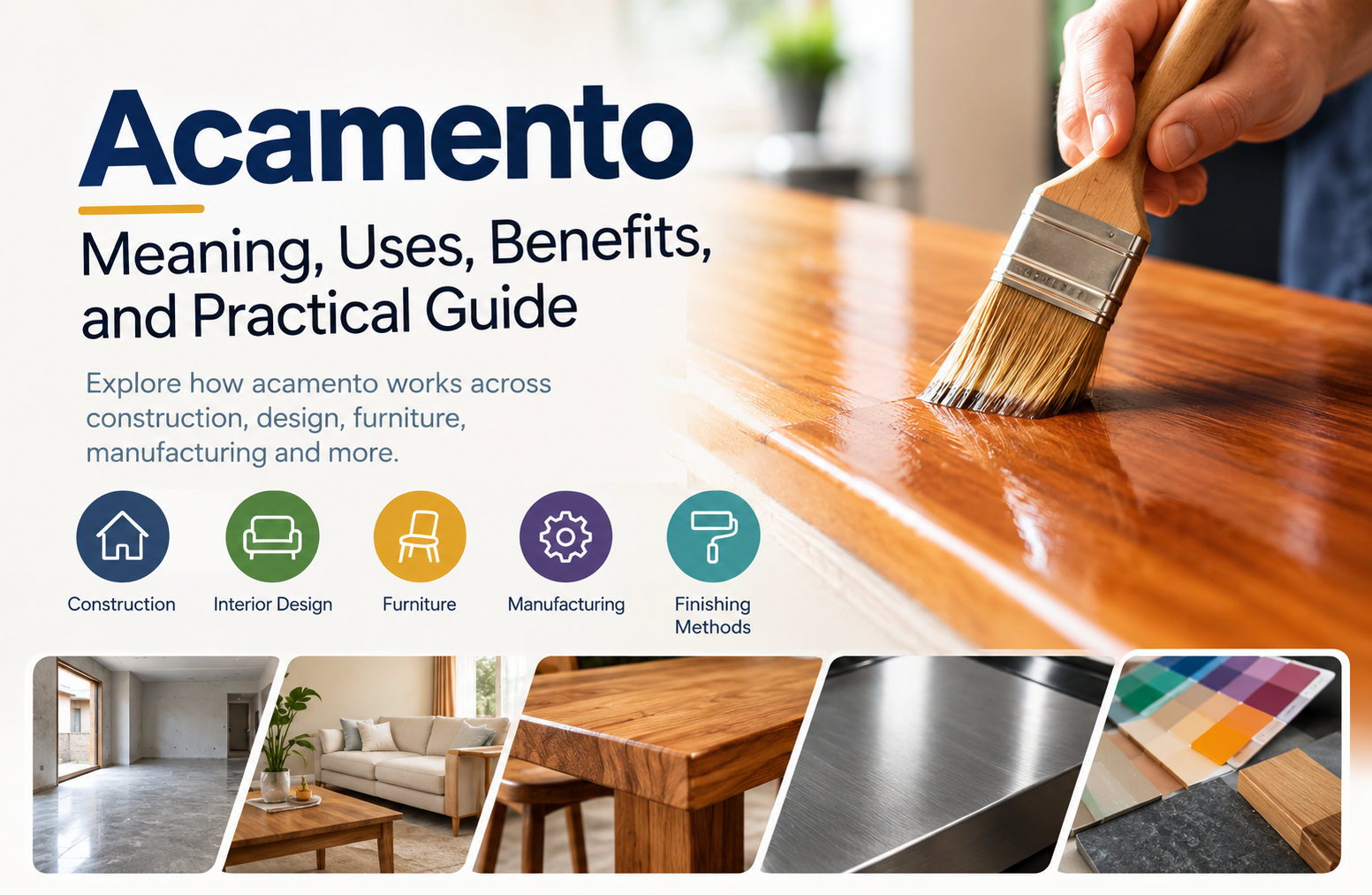
Acamento: Meaning, Uses, Benefits, and Practical Guide
Acamento is a term that has recently attracted attention online, but its meaning is not as straightforward as many articles suggest. In most contexts, it is associated with finishing, refinement, completion, and the final treatment that makes a product, surface, project, or piece of work ready for use. However, there is an important distinction between the spelling “acamento” and the established Portuguese word “acabamento.”
If you searched for this term because you encountered it in construction, furniture, interior design, manufacturing, crafts, or online content, the safest approach is to understand the linguistic background first and then look at how the idea is applied in practical work. This article separates established meaning from newer online interpretations and explains where the concept genuinely has value.
What Does Acamento Mean?
The simplest way to understand acamento is as the final stage of improving, completing, or refining something.
Think about a wooden table. Cutting and assembling the wood creates the basic table, but the work does not necessarily end there. The surface may need sanding, staining, painting, sealing, or polishing. Those final operations affect how the table looks, feels, performs, and survives everyday use.
The same principle appears in construction. A building can have its structure completed while still requiring flooring, painting, tiling, fixtures, surface treatments, trim, and other finishing work.
This distinction matters because finishing is not merely decoration. A suitable finish can influence:
- Appearance
- Surface protection
- Durability
- Ease of cleaning
- Moisture resistance
- Texture
- User comfort
- Maintenance requirements
- Perceived quality
The established Portuguese term acabamento has precisely this relationship with finishing and completion.
So when people use acamento to describe a finishing concept, they are generally pointing toward this broader idea of bringing something to a completed and refined state.
Acamento and the Portuguese Word Acabamento
One of the biggest sources of confusion is spelling.
“Acabamento” is an established Portuguese noun. Portuguese dictionaries define it in terms of finishing, completing, perfecting, concluding, and the degree of perfection with which a work is presented.
That makes the connection between the two terms understandable, but it would be inaccurate to automatically claim that “acamento” is simply the standard Portuguese spelling.
The distinction is important for anyone writing professionally, translating documents, purchasing materials, or communicating with Portuguese-speaking architects, contractors, manufacturers, or suppliers.
What acabamento means
In Portuguese, acabamento can refer to:
- The act of finishing something
- A final touch or refinement
- The quality of the completed work
- Finishing operations in industrial production
- Surface treatments and decorative finishes
- Completion or conclusion
Therefore, if you are dealing with formal Portuguese terminology, acabamento is the safer established term.
Why does “acamento” appear online?
There are several possible reasons.
It can result from:
- A spelling variation
- A shortened or informal adaptation
- Search behavior
- Content creators using the word as a conceptual label
- Confusion with acabamento
- Websites giving the word a broader modern meaning
Current online usage is inconsistent. Some websites use acamento as a synonym for finishing, while others give it broader conceptual meanings. Those claims should not be accepted automatically.
The important lesson is simple: context matters more than the keyword itself.
Acamento in Construction
Construction provides one of the clearest examples of why finishing deserves serious attention.
A building has several stages. Structural work establishes the physical framework, while later work turns that framework into a usable environment.
Finishing can include:
- Wall plastering
- Painting
- Flooring
- Tiling
- Ceiling treatments
- Door and window finishing
- Decorative moldings
- Countertops
- Surface coatings
- Fixtures
- Joinery
- Waterproofing-related surface treatments
- Final detailing
A poorly finished building can technically be complete but still feel unfinished.
That is why professional construction specifications normally distinguish between structural components and finish materials.
Why finishing quality matters
Imagine two rooms with identical dimensions and identical structural layouts.
One has uneven paint, poorly aligned tiles, inconsistent joints, rough edges, and badly fitted trim.
The other has straight lines, consistent surfaces, carefully fitted materials, and appropriate protective treatments.
The basic architecture is the same. The experience is completely different.
This is one of the most useful ways to understand acamento: the finishing stage translates technical construction into the final user experience.
Acamento in Interior Design
Interior design depends heavily on finishing choices because surfaces occupy so much of the visual field.
Walls, floors, cabinets, countertops, furniture, doors, and hardware all contribute to the final appearance.
A designer may begin with a concept such as:
- Warm and natural
- Minimalist
- Industrial
- Contemporary
- Traditional
- Rustic
- Luxury
- Functional and low-maintenance
Finishing materials help turn that concept into reality.
For example, natural wood can be left relatively understated, stained to alter its appearance, painted for a uniform finish, or protected with a clear coating that preserves the visual character of the material.
The choice should not be based on appearance alone.
A kitchen surface experiences different conditions from a bedroom wall. A bathroom floor faces different moisture and slip considerations from a decorative living-room wall.
Good finishing decisions therefore combine aesthetic goals with functional requirements.
Acamento in Furniture and Woodworking
Furniture is another area where finishing has a direct effect on quality.
A piece of furniture can be structurally strong but still have a poor final result if its surfaces are rough or inconsistently treated.
Common woodworking finishing processes include:
- Sanding
- Staining
- Painting
- Varnishing
- Oil finishing
- Waxing
- Sealing
- Polishing
Each option produces different characteristics.
A glossy coating may emphasize smoothness and reflect light. A matte treatment can create a quieter appearance. An oil finish may preserve a more natural visual character while changing the tactile feel of the wood.
The preparation stage is often more important than the final coating
This is an important practical lesson.
People sometimes focus heavily on choosing the paint, varnish, stain, or polish while overlooking surface preparation.
A premium coating cannot reliably hide:
- Deep scratches
- Uneven sanding
- Dust
- Contamination
- Moisture problems
- Poor repairs
- Incorrect substrate preparation
In real finishing work, preparation and application work together.
That principle applies far beyond furniture.
Acamento in Metal Finishing
Metal products also require finishing for both appearance and performance.
Depending on the material and intended application, finishing may involve:
- Polishing
- Brushing
- Powder coating
- Painting
- Plating
- Anodizing
- Protective coatings
- Surface texturing
The objective can be aesthetic, protective, functional, or a combination of all three.
For example, a surface treatment can change the visual appearance while also helping protect the underlying material from environmental exposure.
The appropriate treatment depends on the metal, operating conditions, required appearance, expected wear, and maintenance environment.
This is why there is no universally “best” finish.
There is only a finish that is appropriate or inappropriate for a particular application.
Acamento in Manufacturing
Manufacturing demonstrates another important aspect of finishing: consistency.
When one product is finished by hand, small differences may be acceptable depending on the product. In mass production, however, manufacturers usually need much tighter control.
A finishing process may therefore involve:
- Surface preparation
- Cleaning
- Application of the selected treatment
- Drying or curing
- Inspection
- Measurement
- Quality control
- Packaging
The final inspection is particularly important.
A manufacturer may evaluate factors such as:
- Surface uniformity
- Color consistency
- Thickness
- Adhesion
- Gloss
- Texture
- Defects
- Dimensional accuracy
This reveals an important point about acamento: finishing is not necessarily a purely artistic activity. In industrial settings, it can be a controlled technical process.
Acamento in Graphic and Printed Products
The concept also applies to printed materials.
After a document, package, label, book, or promotional item is printed, additional operations may determine its final form.
These can include:
- Cutting
- Folding
- Binding
- Laminating
- Embossing
- Foil application
- Die cutting
- Coating
The Portuguese definition of acabamento specifically includes final operations in industrial graphic production that give a printed object its final form.
This is a useful example because it shows that finishing does not always mean painting or polishing.
The broader idea is the collection of final processes that transform a basic output into the intended finished product.
The Difference Between Completion and Refinement
One of the most useful ways to think about acamento is to separate completion from refinement.
Something can be complete without being refined.
For example, a website may have:
- All required pages
- Working navigation
- Correct information
- A functioning contact form
Technically, the website is complete.
But refinement might involve:
- Fixing inconsistent spacing
- Improving typography
- Correcting broken mobile layouts
- Removing unnecessary elements
- Improving image quality
- Checking accessibility
- Testing forms
- Reviewing spelling
- Improving loading performance
The first stage makes something functional.
The second stage makes it polished.
That difference is at the heart of the modern conceptual use of acamento.
The Benefits of Good Finishing
Quality finishing provides several practical benefits.
1. Better appearance
This is the most obvious advantage.
Consistent surfaces, clean edges, appropriate textures, and carefully selected materials make finished products look more professional.
2. Improved durability
Some finishes protect materials from moisture, abrasion, dirt, oxidation, ultraviolet exposure, or everyday wear.
However, the level of protection depends entirely on the material and treatment. A finish should never be assumed to provide unlimited protection.
3. Easier maintenance
A suitable surface can be easier to clean and maintain.
This is particularly important in:
- Kitchens
- Bathrooms
- Commercial buildings
- Healthcare environments
- Hospitality spaces
- High-traffic areas
4. Better user experience
Texture, smoothness, edges, temperature, reflectivity, and visual consistency can influence how people interact with a product or space.
5. Higher perceived quality
People naturally judge workmanship through visible details.
Straight joints, consistent surfaces, clean edges, and careful detailing can make an object appear more professionally manufactured or installed.
Common Acamento Mistakes
A useful guide should also explain what can go wrong.
Choosing appearance over function
A finish can look excellent in a sample and still be unsuitable for the actual environment.
A bathroom, outdoor surface, kitchen countertop, and bedroom wall have different requirements.
Ignoring the substrate
The underlying material affects the final result.
Before applying a finish, determine whether the surface is:
- Wood
- Metal
- Concrete
- Plaster
- Ceramic
- Stone
- Plastic
- Composite material
Different substrates require different preparation and compatible treatments.
Rushing preparation
Skipping cleaning, sanding, priming, curing, or repair work often produces visible defects later.
Using incompatible materials
Not every coating works with every substrate.
Compatibility should be confirmed through the manufacturer’s technical documentation rather than assumed.
Focusing only on the initial price
A cheaper finish can become more expensive if it requires frequent repairs or replacement.
The better comparison is often total lifecycle value, not purchase price alone.
How to Choose the Right Finish
If you are selecting a finish for a real project, use a structured approach.
Step 1: Identify the substrate
Determine exactly what you are finishing.
Do not choose a treatment simply because it worked on another material.
Step 2: Define the environment
Ask where the finished item will be used.
Consider:
- Indoor or outdoor exposure
- Moisture
- Heat
- Sunlight
- Traffic
- Abrasion
- Chemicals
- Cleaning methods
Step 3: Define the desired appearance
Decide whether you want:
- Matte
- Satin
- Semi-gloss
- Gloss
- Natural
- Textured
- Colored
- Transparent
Step 4: Consider maintenance
Ask how often the surface can realistically be cleaned, repaired, or refinished.
A visually impressive finish that requires unrealistic maintenance may not be the best solution.
Step 5: Check technical compatibility
Read the manufacturer’s instructions and technical documentation.
Look for information about:
- Surface preparation
- Application method
- Drying time
- Curing
- Temperature
- Humidity
- Coverage
- Compatibility
- Maintenance
Step 6: Test before committing
Whenever possible, test the finish on a small, representative area.
Lighting can change how colors and textures appear, so evaluate the sample under conditions similar to the final environment.
Acamento vs Finishing
For English-speaking readers, “finishing” is generally the clearer term.
The word finish can describe both completing an activity and the appearance or treatment of a surface. Acabamento is commonly used in Portuguese for a surface finish.
Therefore, depending on your audience:
| Term | Practical interpretation |
| Acamento | Emerging or inconsistent online usage |
| Acabamento | Established Portuguese term |
| Finishing | Clear English term |
| Surface finish | Technical English phrase |
| Final treatment | Useful descriptive phrase |
| Refinement | Broader conceptual meaning |
If you are writing a technical document in English, “surface finish,” “finishing,” or the specific treatment name is usually clearer than relying on an unfamiliar word.
Is Acamento a Technical Industry Standard?
This question deserves a careful answer.
Acamento should not automatically be treated as a standardized technical term simply because it appears frequently online.
The established Portuguese term acabamento has documented meanings related to completion, finishing, refinement, and final production operations.
By contrast, online material using “acamento” varies considerably. Some pages use it as a synonym for finishing, while others give it broader conceptual meanings.
That does not make every use meaningless.
It does mean readers should distinguish between:
- Established terminology
- Informal terminology
- Marketing language
- A coined concept
- A spelling variation
- A genuine technical specification
This distinction is particularly important when money, construction quality, safety, or contractual specifications are involved.
How to Evaluate Claims About Acamento Online
If you encounter a website claiming that acamento is a revolutionary platform, technology, framework, or certified methodology, do not accept the claim simply because several websites repeat it.
Check for independent evidence.
Look for:
- A clearly identified organization
- Named authors or experts
- Primary documentation
- Technical specifications
- Independent references
- Established industry usage
- Verifiable products or services
- Transparent contact information
Repeated articles are not necessarily independent evidence.
Ten websites repeating the same unsupported claim can still represent one unverified claim.
This is especially relevant for unusual search terms because content can spread online faster than reliable definitions are established.
A Practical Quality-Control Checklist
Whether you are finishing furniture, renovating a room, manufacturing a product, or preparing a digital project, a final inspection can follow a simple checklist.
Visual inspection
Look for:
- Uneven color
- Scratches
- Bubbles
- Runs
- Cracks
- Gaps
- Misalignment
- Rough edges
- Inconsistent texture
Functional inspection
Ask:
- Does the finish perform its intended function?
- Is the surface easy to maintain?
- Is the material compatible?
- Does the surface tolerate the expected environment?
Consistency inspection
Compare different sections of the finished work.
Small differences that are invisible in isolation can become obvious when several surfaces are viewed together.
Documentation check
For professional work, retain product specifications, batch information, application instructions, and maintenance requirements where appropriate.
Good documentation can be valuable if repairs or future refinishing are required.
Real-World Example: Finishing a Wooden Table
Consider a simple wooden dining table.
The process might begin with sanding to produce an even surface. The wood could then receive a stain or remain natural, depending on the desired appearance. A protective finish can then be applied according to the product’s instructions.
But the important decisions happen before the final coat.
The table’s intended use determines what matters.
A decorative side table may prioritize appearance. A dining table may require greater resistance to routine cleaning and spills. A workshop bench has entirely different requirements because abrasion and impact are expected.
The word “finish” therefore describes only the visible endpoint.
The real expertise lies in matching the treatment to the material and the environment.
Real-World Example: Finishing a Room
Now consider a newly constructed room.
The structure may already be complete, but the space might still require:
- Wall preparation
- Paint
- Flooring
- Skirting or trim
- Doors
- Hardware
- Lighting
- Cabinetry
- Fixtures
- Final cleaning
A good result requires coordination.
Installing a delicate finished floor before messy work is completed can create avoidable damage. Painting before certain dusty operations are complete can also create unnecessary rework.
This illustrates another principle: finishing quality depends on sequencing, not just material selection.
Why Finishing Should Be Planned Early
Although finishing happens near the end of a project, it should often be considered near the beginning.
Why?
Because final materials can affect earlier decisions.
For example:
- Floor thickness can affect door clearances.
- Tile dimensions can affect layout.
- Cabinet dimensions depend on finished wall and floor conditions.
- Coating requirements can affect substrate preparation.
- Lighting affects how colors and textures appear.
- Maintenance requirements can influence material selection.
Waiting until the final stage to think about finishing can therefore create expensive changes.
The best approach is to define the desired final result early and then work backward.
Sustainability and Finishing Choices
Finishing decisions can also affect environmental impact.
A durable treatment may reduce the frequency of replacement. However, sustainability cannot be determined from durability alone.
Other factors may include:
- Material sourcing
- Product lifespan
- VOC emissions
- Waste
- Packaging
- Repairability
- Recyclability
- Maintenance requirements
- End-of-life disposal
Avoid simplistic claims such as “natural always means sustainable” or “expensive always means better.”
The environmentally preferable option depends on the complete lifecycle and application.
Acamento as a Broader Idea
Beyond physical products, the underlying idea of finishing can be applied to many forms of work.
A writer drafts an article and then edits it.
A designer creates a layout and then checks spacing, hierarchy, and usability.
A developer builds a feature and then tests edge cases.
A photographer captures an image and then performs final color and exposure adjustments.
In each case, the final refinement stage can significantly change the quality of the result.
This is why the broader conceptual interpretation of acamento has appeal even when the exact terminology is not standardized.
The underlying principle is practical:
Finishing is where details become visible.
When Acamento Matters Most
Finishing deserves particular attention when:
- The surface will receive heavy use.
- Appearance is commercially important.
- The product will face moisture or weather.
- Maintenance costs are significant.
- The work will be difficult to repair later.
- Small defects will be highly visible.
- Multiple materials must visually work together.
- The final result represents a professional brand.
In low-risk decorative projects, experimentation may be reasonable.
In structural, industrial, commercial, or safety-sensitive applications, technical specifications should take priority over informal terminology.
Frequently Asked Questions
What does acamento mean?
Acamento is commonly used online to describe finishing, refinement, completion, or the final treatment that makes a product, surface, or project ready for use. The established Portuguese term closely associated with this meaning is acabamento.
Is acamento the same as acabamento?
Not necessarily as a matter of formal terminology. Acabamento is an established Portuguese word meaning finishing, completion, and refinement. “Acamento” is used inconsistently online and should not automatically be treated as its standard equivalent.
Where is acamento used?
Online usage connects the concept with construction, interior design, furniture, woodworking, manufacturing, metalwork, graphic production, and general project refinement.
Why is finishing important?
Finishing can affect appearance, durability, maintenance, surface protection, usability, and perceived quality. The correct treatment depends on the material and the environment.
Is acamento an official technical term?
The word should be treated cautiously. Established technical terminology is usually more specific, such as surface coating, polishing, powder coating, anodizing, painting, or another defined finishing process.
How do I choose the right finish?
Identify the substrate, understand the environment, define the required appearance, consider maintenance, verify product compatibility, follow technical instructions, and test a representative sample before full application.
Conclusion
Acamento is best understood through the broader concept of finishing and refinement, while recognizing that the established Portuguese word acabamento has the clearest documented connection to this meaning. In construction, furniture, manufacturing, graphic production, interior design, and craftsmanship, finishing is far more than a cosmetic final step.
It can influence durability, maintenance, appearance, usability, and the overall quality of the finished result.
The most important practical lesson is to avoid choosing a finish based solely on appearance or price. Start with the material, environment, performance requirements, maintenance needs, and intended visual result. Then select a treatment supported by reliable technical information.
For anyone researching the keyword itself, there is another lesson: distinguish established terminology from newer online interpretations. A term appearing on many websites is not automatically a standardized technical concept.
Good finishing ultimately comes down to the same principle across almost every field: the quality of the final details determines how complete the work feels and how well it performs in real use.