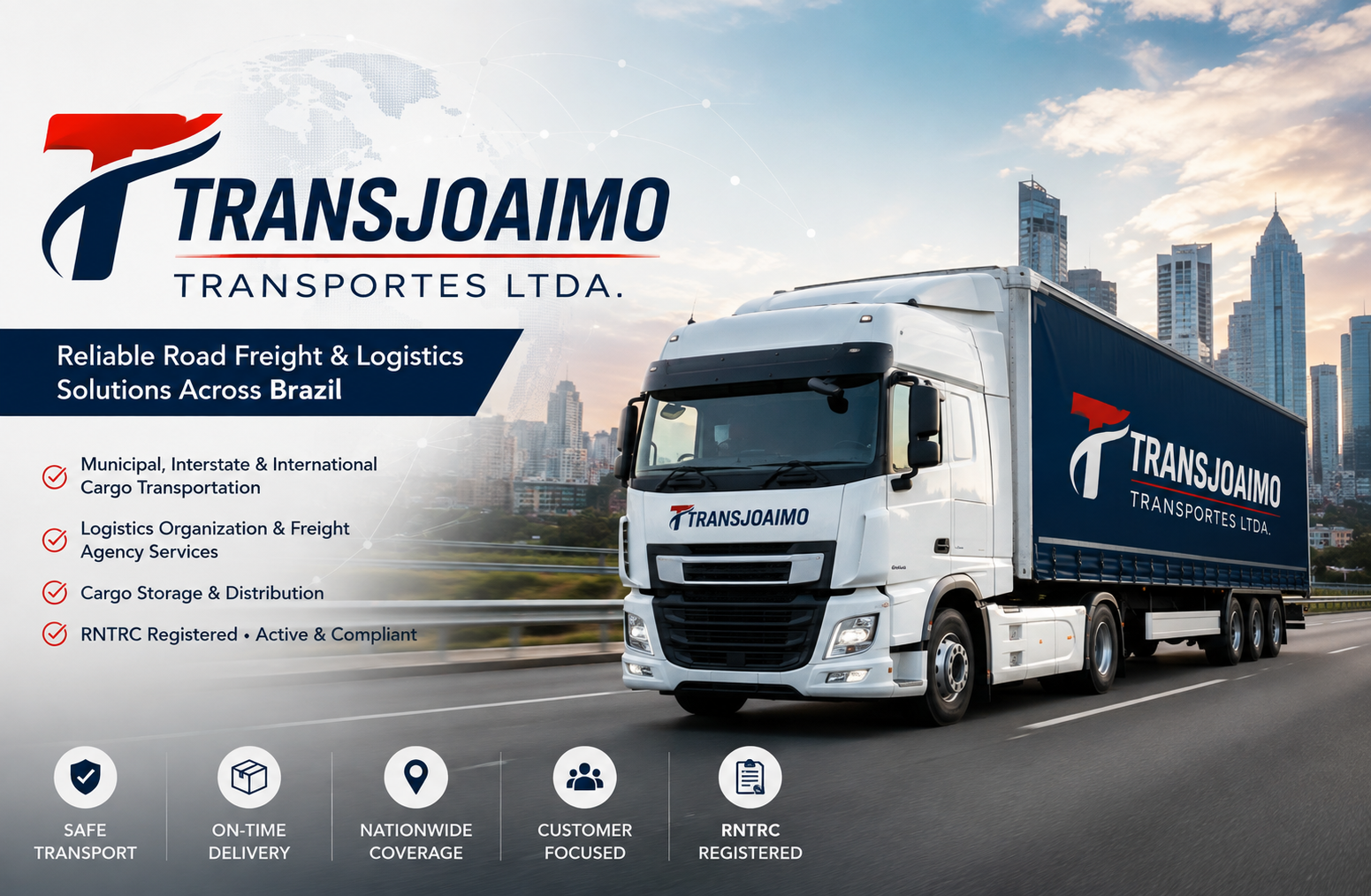
Transjoaimo: Company Profile, Services, History, and What to Know
Transjoaimo is the trade name associated with Joaimo Silva Rodrigues Transportes Ltda, a Brazilian road freight and logistics company registered in Barueri, São Paulo. Public business records identify the company as an active small enterprise whose principal activity is municipal road freight transportation. Its business registration dates back to August 12, 2005, giving it a long operating history in the Brazilian transport sector.
For someone searching for information about Transjoaimo, however, a company name alone does not tell the whole story. A useful profile should explain what the business is registered to do, where it operates, what its public records confirm, what those records do not prove, and what customers should check before engaging a transport company.
This article brings those details together in one place while separating verified registration information from assumptions that cannot be confirmed through reliable public records.
What Is Transjoaimo?
Transjoaimo is the commercial name of Joaimo Silva Rodrigues Transportes Ltda, a limited liability company based in Barueri, São Paulo, Brazil.
Its principal registered economic activity is road transportation of cargo, excluding dangerous products and removals, within a municipality. Public records also associate the company with additional activities covering intermunicipal, interstate, and international cargo transportation, cargo storage, freight agency services, logistics organization, customs dispatch services, transportation of dangerous goods, and moving services.
That distinction is important.
A company’s registered secondary activities describe areas in which it is legally classified or registered to operate. They do not necessarily mean that every listed service is actively marketed to customers today.
For that reason, anyone considering the company for a specific shipment should confirm the exact service, route, cargo type, insurance arrangements, price, delivery schedule, and documentation requirements before booking.
Transjoaimo at a Glance
The publicly available registration information provides several useful facts about the business.
| Detail | Publicly reported information |
| Trade name | Transjoaimo |
| Legal name | Joaimo Silva Rodrigues Transportes Ltda |
| CNPJ | 10.385.087/0001-16 |
| Founded | August 12, 2005 |
| Legal structure | Sociedade Empresária Limitada |
| Business size | Empresa de Pequeno Porte |
| Status | Active |
| Registered capital | R$500,000 |
| Headquarters | Barueri, São Paulo, Brazil |
| Principal activity | Municipal road freight transportation |
| RNTRC | 045260717 |
| RNTRC category | ETC |
| Administrator | Joaimo Silva Rodrigues |
These details come from public company and transport registration databases. The company’s registration status was reported as active in 2026, while transport registry information lists its RNTRC registration as active.
Transjoaimo Company History
Transjoaimo traces its registered beginning to August 12, 2005. That date is consistently reported in public business records.
This provides an important piece of context.
A transport company operating for many years has had to work within a sector affected by fuel prices, vehicle maintenance, road conditions, regulatory requirements, freight demand, customer expectations, and changing logistics technology.
It would be inaccurate to assume that longevity automatically means superior service. Time in business is only one factor. Still, a registration history extending back to 2005 is useful when evaluating the company’s background.
Public records also indicate that Joaimo Silva Rodrigues became the company’s registered partner-administrator in August 2013.
There is much less reliable public information about the company’s internal history, including its early fleet size, original customer base, annual revenue, or operational milestones. Those details should not be invented simply to make a company profile appear more complete.
That is one of the most important principles when researching privately held businesses: a missing public fact is better than a fabricated fact.
Where Is Transjoaimo Located?
The registered headquarters is listed at:
Avenida Henrique Gonçalves Baptista, 1765
Jardim Belval
Barueri, São Paulo
CEP 06420-130
Brazil
Public company records identify this as the company’s registered headquarters and matrix establishment.
Why Barueri Matters for Logistics
Barueri is part of the Greater São Paulo business environment, making its location relevant to a transportation company.
The surrounding region contains a large concentration of commercial operations, warehouses, industrial facilities, retailers, distributors, and service businesses. This creates a natural demand for freight transportation.
For a carrier based in this area, proximity to major commercial corridors can be valuable because transport efficiency depends heavily on pickup density, route planning, vehicle utilization, and access to customers.
However, the location should not be confused with proof of a particular service area.
A company having its headquarters in Barueri does not automatically mean it provides direct delivery to every Brazilian state or city. Route availability should always be confirmed for the individual shipment.
What Services Does Transjoaimo Provide?
The company’s public registration information gives a broader picture than its principal activity alone.
Municipal Cargo Transportation
The principal registered activity concerns road freight transportation within a municipality, excluding certain categories such as dangerous products and removals under that specific classification.
Municipal freight can involve movements such as:
- Commercial deliveries
- Warehouse transfers
- Supplier deliveries
- Retail distribution
- Business-to-business cargo movement
- Local collection and delivery operations
The exact nature of a shipment depends on the customer’s contract and the carrier’s available equipment.
Intermunicipal and Interstate Freight
Public records also list road freight transportation between municipalities and states, including international road transportation under the relevant secondary classification.
This is important because freight requirements change significantly as the distance increases.
A local delivery may be relatively simple, while a longer route can involve:
- Multiple checkpoints
- Longer transit times
- More complex scheduling
- Additional documentation
- Greater exposure to delays
- Different insurance considerations
- More detailed cargo tracking requirements
Customers should therefore ask for a shipment-specific quotation rather than relying on a general statement that a carrier operates nationally.
Logistics Organization
The registration data also includes an activity related to organizing cargo transportation logistics.
Logistics organization is broader than simply moving a truck from one location to another.
It can involve coordinating different parts of a shipment, including origin, destination, timing, documentation, cargo handling, and transportation resources.
For businesses, this distinction matters because logistics performance is often determined before the vehicle even reaches the loading point.
Freight Agency Services
Another registered activity relates to cargo agency services, excluding maritime transportation.
Freight agency work can involve arranging or coordinating transportation rather than simply operating a vehicle.
This means customers should ask an important question when requesting a quotation:
Who will physically transport the cargo?
The answer may be the same company, a contracted carrier, or another transportation partner depending on the arrangement.
Storage and Cargo Handling
Public registration information also lists storage of goods for third parties, with exclusions specified by the relevant economic classification.
Storage can be useful when transportation and warehousing need to work together.
For example, a business may need goods collected from a supplier, held temporarily, and later distributed according to customer orders.
But registration alone does not establish the current size, capacity, security arrangements, temperature controls, or operating hours of any storage facility. Those details should be confirmed directly.
Dangerous Goods
One secondary registration category concerns road transportation of dangerous products.
This is an area where customers should be particularly careful.
Dangerous goods require specific handling, documentation, equipment, training, and regulatory compliance. A company registration entry should not be treated as proof that a particular dangerous-goods shipment can be accepted without additional checks.
Before booking such a shipment, confirm:
- The exact classification of the material.
- Whether the company currently accepts that category.
- Required packaging.
- Required documentation.
- Insurance coverage.
- Vehicle requirements.
- Driver and operational requirements.
- Applicable Brazilian regulations.
Understanding the RNTRC Registration
One of the more useful pieces of information associated with Transjoaimo is its RNTRC registration.
The Registro Nacional de Transportadores Rodoviários de Cargas, commonly called RNTRC, is Brazil’s national registry for remunerated road freight transporters.
According to Brazil’s National Land Transport Agency, or ANTT, remunerated road freight transporters must be registered in the RNTRC under categories including Transportador Autônomo de Cargas, Empresa de Transporte Rodoviário de Cargas, or Cooperativa de Transporte Rodoviário de Cargas.
Transjoaimo is listed with RNTRC number 045260717 and category ETC, meaning Empresa de Transporte Rodoviário de Cargas. Public transport registration information lists the registration as active.
For anyone evaluating a carrier, this is more meaningful than simply seeing a company name on a directory.
The ANTT explains that the RNTRC is part of the regulatory framework for remunerated road freight transportation in Brazil.
Why RNTRC Status Matters to Customers
A customer hiring a freight carrier should not evaluate the business based solely on price.
Regulatory status is part of the risk assessment.
The ANTT states that the RNTRC applies to companies and other transport operators performing remunerated road freight services. It also maintains public information and regulatory systems related to registered transporters.
That gives customers a practical verification point.
Before contracting transportation, it is sensible to check:
- The legal company name
- CNPJ
- RNTRC number
- Registration status
- Carrier category
- Vehicle documentation
- Insurance requirements
- Cargo restrictions
- Contract terms
A valid registration does not guarantee that every shipment will be handled perfectly. It simply establishes an important regulatory baseline.
How to Evaluate Transjoaimo for a Shipment
If you are considering Transjoaimo for a business shipment, avoid making the decision from a company profile alone.
A better approach is to evaluate the actual transportation requirement.
Step 1: Define the Cargo
Start with the basics.
Record:
- Type of goods
- Number of packages
- Total weight
- Dimensions
- Declared value
- Pickup location
- Delivery location
- Loading requirements
- Unloading requirements
For unusual or regulated products, provide complete information before receiving a quotation.
A carrier cannot accurately price or plan a shipment without knowing what it is expected to transport.
Step 2: Confirm the Route
Ask whether the exact origin and destination are served.
Do not simply ask whether the company “works throughout Brazil.”
A useful quotation should identify:
- Pickup city
- Delivery city
- Expected transit time
- Collection window
- Delivery window
- Any intermediate handling
- Whether another carrier will participate
This prevents misunderstandings later.
Step 3: Ask How the Cargo Will Be Handled
Cargo handling can affect the risk of damage just as much as the road journey itself.
Ask whether the shipment will be:
- Direct
- Consolidated with other cargo
- Transferred between vehicles
- Temporarily stored
- Handled at a distribution point
For fragile, expensive, or time-sensitive goods, these details matter.
Step 4: Check Documentation
Brazilian road freight operations involve documentation and regulatory requirements.
The ANTT notes that transport inspections can involve documents such as the invoice, transport document, cargo manifest, and other documentation related to the vehicle, driver, and operation.
Customers should make sure their own documentation is complete before pickup.
A documentation problem can delay an otherwise well-planned shipment.
Step 5: Understand Insurance
Insurance deserves more attention than it often receives.
Do not assume that saying a shipment is “insured” answers every question.
Ask:
- What type of coverage applies?
- Who is the insured party?
- What is the coverage limit?
- Are there exclusions?
- What happens if the cargo is damaged?
- What happens in case of theft?
- What documentation is required for a claim?
The ANTT’s current RNTRC requirements include rules concerning transport-related insurance arrangements.
For valuable cargo, obtain the relevant insurance details in writing.
Step 6: Compare the Total Cost
The cheapest quotation is not necessarily the cheapest transportation solution.
Compare:
Quoted freight + additional fees + handling + storage + insurance + potential delays = practical transportation cost
A low base rate can become expensive if the shipment requires unexpected handling or storage.
For businesses, reliability can also have an economic value.
If a late delivery stops production, causes a missed retail deadline, or creates customer complaints, the financial impact can be much larger than the freight invoice.
What Customers Should Ask Before Booking
A short checklist can make the evaluation process much easier.
Ask the carrier:
- Is my exact route currently served?
- What is the estimated transit time?
- Is the shipment direct or consolidated?
- What vehicle will be used?
- Will another carrier handle any portion of the route?
- What documents do you need before pickup?
- What insurance applies?
- Are there cargo restrictions?
- What happens if delivery is delayed?
- How is proof of delivery provided?
- How can the shipment be tracked?
- What are the cancellation terms?
- Are loading and unloading included?
- Are storage charges possible?
- Is the quotation valid for a specific period?
These questions are useful regardless of which transportation company you choose.
Strengths Suggested by the Public Record
A careful assessment of the available information reveals several positive signals.
Long Registration History
The company has a registered history dating to 2005.
That gives potential customers a meaningful historical reference point, although it should not be treated as a guarantee of current service quality.
Active Company Status
Public business databases report the company as active.
An active registration is preferable to relying on an outdated directory listing.
Registered Transport Activity
The company’s principal activity is directly related to road cargo transportation, rather than being an unrelated business that merely advertises delivery services.
RNTRC Registration
The public transport registry information identifies an active RNTRC registration and an ETC category.
Together, these details provide a stronger foundation for research than an anonymous online listing.
What the Public Record Does Not Tell Us
This is where many online company profiles become misleading.
Public registration information does not automatically establish:
- Customer satisfaction
- On-time delivery percentage
- Average delivery time
- Current fleet size
- Current number of employees
- Annual revenue
- Profitability
- Number of active customers
- Damage rate
- Claims history
- Real-time tracking quality
- Current pricing
- Service quality
- Driver performance
Those are operational and commercial metrics.
Unless they are supported by credible evidence, they should not be presented as established facts.
This distinction is especially important when researching smaller private companies.
A responsible article should tell readers what is known, what is reasonably inferred, and what remains unverified.
Transjoaimo and the Broader Logistics Market
The role of a freight carrier becomes easier to understand when viewed as part of a larger supply chain.
A shipment may pass through several stages:
Supplier → Pickup → Transport → Distribution or Storage → Final Delivery
The carrier sits in the middle of that process, but its performance can influence every stage.
A delayed pickup can disrupt warehouse planning.
A poorly documented shipment can create administrative problems.
A damaged product can generate claims.
A late delivery can affect inventory availability.
This is why transportation should be treated as an operational function rather than simply a purchasing expense.
For businesses, selecting a carrier is ultimately a risk-management decision.
Practical Use Cases
A transport company with the registrations associated with Transjoaimo may be relevant to several types of business transportation.
Retail Distribution
Retail businesses frequently need products moved from suppliers or storage facilities to commercial locations.
The key considerations are usually:
- Delivery schedules
- Volume
- Route frequency
- Handling
- Proof of delivery
Industrial Supply
Factories may need components, materials, tools, and finished products moved between suppliers and production facilities.
For this type of work, consistency can be more important than one-off pricing.
Warehouse Transfers
Companies sometimes move goods between warehouses rather than directly to customers.
This can require coordination between storage capacity and vehicle availability.
Business-to-Business Deliveries
Commercial customers often need scheduled deliveries that fit receiving hours.
A delivery that arrives outside a warehouse’s operating window can create unnecessary waiting time and additional costs.
Long-Distance Freight
Longer routes introduce additional variables, including weather, road conditions, driver scheduling, fuel costs, regulatory compliance, and vehicle availability.
For these shipments, the quotation should include a clear delivery expectation rather than only a price.
How to Reduce Freight Problems
Many transportation problems begin before the truck leaves.
There are several practical ways to reduce avoidable issues.
Package Properly
Use packaging appropriate for the cargo’s weight, shape, fragility, and transportation conditions.
Weak packaging transfers unnecessary risk to everyone involved.
Label Clearly
Labels should make the shipment easy to identify and handle.
Where applicable, include handling instructions and other required information.
Provide Accurate Measurements
Incorrect dimensions or weight can affect vehicle selection, pricing, and loading.
Declare the Cargo Honestly
Do not describe regulated or sensitive goods vaguely.
Accurate cargo information allows the carrier to determine whether it can legally and operationally accept the shipment.
Confirm Delivery Requirements
If the receiver has limited operating hours, security procedures, appointment requirements, or unloading restrictions, communicate those details before pickup.
Keep Records
Retain:
- Quotation
- Commercial invoice
- Transport documentation
- Shipment identification
- Insurance information
- Delivery confirmation
- Communication regarding exceptions
Good documentation becomes especially valuable if a shipment is delayed or damaged.
Common Mistakes When Researching a Transport Company
There are several mistakes worth avoiding when evaluating any carrier.
Mistaking Registration for a Recommendation
An active company registration is evidence of business status. It is not a customer review.
Trusting Old Contact Information
Directories can contain outdated phone numbers, emails, addresses, or websites.
Always confirm important contact details before sending sensitive documents or valuable cargo.
Assuming Every Registered Service Is Currently Offered
Secondary economic classifications can be broad.
Always verify current operational availability.
Choosing Solely on Price
Freight is not a commodity in every situation.
Two quotations can look similar while offering very different service structures.
Ignoring Insurance Details
A vague statement about insurance is not enough for high-value cargo.
Failing to Confirm Who Actually Carries the Shipment
A logistics company can arrange transportation through partners.
Know whether the quoted provider is the physical carrier or an intermediary.
How Businesses Can Compare Transjoaimo With Other Carriers
A useful comparison should use the same criteria for every company.
Create a simple evaluation table:
| Factor | Carrier A | Transjoaimo | Carrier C |
| Route coverage | |||
| Quoted price | |||
| Transit time | |||
| Insurance | |||
| Tracking | |||
| Direct transportation | |||
| Delivery proof | |||
| Additional fees | |||
| Regulatory status | |||
| Contract terms |
This approach is much better than comparing company names or advertising claims.
For recurring freight, consider measuring actual performance after several shipments.
Track:
- Pickup punctuality
- Delivery punctuality
- Damage incidents
- Documentation errors
- Response time
- Cost variance
- Claim resolution
- Proof-of-delivery speed
After several months, those figures can tell you much more than a marketing page.
A More Careful Way to Interpret Company Data
One of the strongest lessons from researching transportation companies is that public data needs context.
For example, an active CNPJ tells you something about the legal status of a company.
An RNTRC record tells you something about its participation in regulated road freight transportation.
A registered economic activity tells you something about its classification.
None of those records independently tells you whether a particular shipment will arrive on time.
The practical answer comes from combining regulatory verification, commercial terms, operational questions, and actual performance.
That is the approach a serious customer should take.
Is Transjoaimo a Legitimate Company?
Available public registration information supports the conclusion that Transjoaimo corresponds to a real registered Brazilian company rather than merely an informal name.
The company is identified as Joaimo Silva Rodrigues Transportes Ltda, with CNPJ 10.385.087/0001-16, a registered headquarters in Barueri, and an active business status in public records. Its transport information also lists RNTRC 045260717 as active.
That establishes a useful baseline of legitimacy.
It does not, however, constitute an independent guarantee of service quality, financial strength, delivery performance, or suitability for a particular shipment.
Those questions require additional due diligence.
What Should You Verify Before Using Transjoaimo?
If you are preparing to hire the company, the most sensible verification process is straightforward.
Verify the Legal Identity
Make sure the company name and CNPJ on the quotation or contract match the registered business information.
Verify Transport Registration
Check the current RNTRC information for the carrier.
The ANTT provides public information and tools connected to the national transport registry.
Confirm the Exact Service
Ask whether your particular cargo and route are accepted.
Review the Quotation
Make sure the written quotation identifies the major costs and conditions.
Confirm Insurance
Do not leave coverage assumptions undocumented.
Confirm Delivery Expectations
Ask for realistic rather than promotional delivery times.
Keep Written Records
Written communication can reduce misunderstandings over pickup dates, prices, cargo requirements, and delivery conditions.
Frequently Asked Questions
What is Transjoaimo?
Transjoaimo is the trade name of Joaimo Silva Rodrigues Transportes Ltda, a Brazilian road freight and logistics company registered in Barueri, São Paulo.
When was Transjoaimo established?
Public business records list August 12, 2005 as the company’s opening date.
Where is Transjoaimo located?
The registered headquarters is on Avenida Henrique Gonçalves Baptista in Jardim Belval, Barueri, São Paulo, Brazil.
What does Transjoaimo do?
Its principal registered activity is municipal road freight transportation. Secondary registrations cover additional transportation and logistics activities, including intermunicipal and interstate freight, cargo agency services, logistics organization, and storage.
Does Transjoaimo have an RNTRC registration?
Yes. Public transport registration information lists RNTRC number 045260717 under the ETC category and reports the registration as active.
Is Transjoaimo a large transportation company?
Public records classify the business as an Empresa de Pequeno Porte, or small enterprise. That classification should not be confused with a precise measure of fleet size, service capacity, or operational performance.
Conclusion
Transjoaimo is the commercial name associated with Joaimo Silva Rodrigues Transportes Ltda, a Brazilian transportation business with a registered history dating to 2005 and headquarters in Barueri, São Paulo.
Its public records identify road freight transportation as its main activity and show additional registrations covering broader transportation and logistics functions. The company is also associated with an active RNTRC registration under the ETC category.
For potential customers, the most useful takeaway is not simply that the company exists or has operated for many years. The more important question is whether its current capabilities match the specific shipment being planned.
Before making a decision, verify the route, cargo type, transit expectations, documentation, insurance, handling arrangements, total cost, and current regulatory status.
A careful evaluation based on these factors gives a much clearer picture than relying on a company name, directory listing, or low quotation alone.