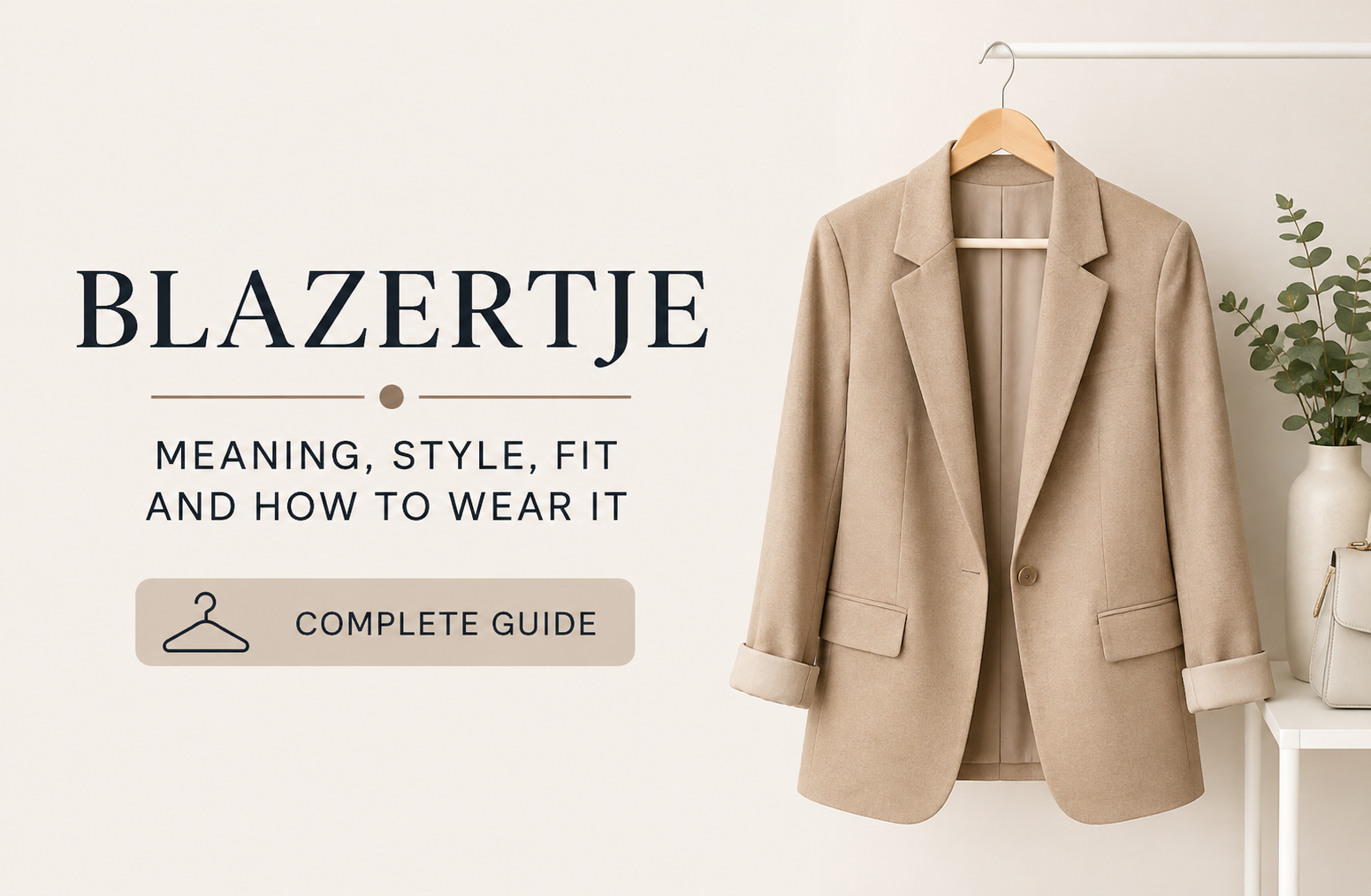
Blazertje: Meaning, Style, Fit, and How to Wear It
A blazertje is a Dutch fashion term built from the word “blazer” and the Dutch diminutive ending “-tje.” In the simplest sense, it can be translated as “little blazer” or “small blazer.” However, understanding the word only through a literal translation can be misleading. In everyday Dutch, diminutives do not always describe physical size. They can also make a word sound more familiar, informal, softer, or more approachable.
That distinction matters because the word is increasingly appearing in online fashion conversations where it is sometimes presented as though it describes one fixed type of jacket. It does not necessarily do that. A garment described as a blazertje can be cropped, lightweight, relaxed, fitted, structured, or even quite similar to a conventional blazer. The actual construction of the garment matters more than the name.
For someone searching for the meaning of the term, the most useful approach is therefore to look at both sides of it: the Dutch language meaning and the way the word is being used in modern fashion. Once that distinction is clear, it becomes much easier to understand how this type of jacket fits into a wardrobe, how to choose the right one, and how to style it without making an outfit look forced.
What Does Blazertje Mean?
The word blazertje comes from the Dutch word “blazer.”
The ending “-tje” is a Dutch diminutive. Dutch uses diminutives extensively, and they can communicate more than simple physical smallness. Depending on context, a diminutive may suggest something small, familiar, casual, friendly, delicate, or simply less formal in tone.
So, as a basic translation:
Blazer → blazertje → little blazer
But this should not be interpreted as a strict fashion specification.
A blazertje does not automatically have to be miniature, child-sized, or cropped at the waist. Nor does the word itself establish a specific fabric, sleeve length, shoulder shape, or level of tailoring.
This is one of the most important points to understand.
When shopping for clothing, consumers often assume that a fashion term represents a precise product category. Some terms do. “Trench coat,” for example, has recognizable construction details. “Bomber jacket” also has a relatively clear design identity.
Blazertje is different.
Its original meaning is linguistic. In fashion discussions, people may use it to suggest a smaller, softer, lighter, more casual, or more approachable interpretation of a blazer. But those characteristics are associations rather than universal technical requirements.
That means the best way to judge one is not by its name alone. Look at the garment itself.
Consider:
- The length
- Shoulder structure
- Fabric weight
- Lining
- Fit
- Lapel shape
- Button arrangement
- Sleeve construction
- Pocket design
- Overall drape
- Intended occasion
These details tell you what you are actually buying.
Is Blazertje a Specific Type of Blazer?
Not in a strict, standardized fashion sense.
This is where many simplified explanations become confusing. It is tempting to define the term as “a lightweight blazer” or “a cropped blazer,” but neither description covers every possible use of the Dutch word.
In casual fashion content, however, the term is often associated with a more relaxed approach to tailoring.
That interpretation makes practical sense. Modern wardrobes increasingly favor clothing that can move between different settings. A jacket may need to work with jeans on one day, tailored trousers on another, and a dress later in the week.
A softer blazer can perform that role well.
The appeal is not necessarily that the jacket is physically smaller. The appeal is that it can preserve some of the visual structure of tailoring without creating the stiffness associated with formal suiting.
This can produce a useful middle ground:
Too casual: T-shirt and sweatshirt
Too formal: Full suit jacket and matching trousers
Middle ground: Soft, versatile tailored jacket
That middle ground is where many contemporary interpretations of the blazertje concept make sense.
Blazertje vs. a Traditional Blazer
The difference between a blazertje and a traditional blazer is best understood through construction and styling rather than terminology.
A conventional blazer can range from very casual to highly structured. It may contain shoulder padding, substantial interfacing, a full lining, a defined waist, and a firm fabric.
A softer interpretation may remove some of that structure.
Structure
Traditional tailoring often relies on internal construction to maintain a crisp silhouette.
A more relaxed jacket may use less padding and fewer internal layers. The shoulder can follow the body’s natural shape rather than creating a strong, formal line.
This changes the way the jacket feels.
A highly structured blazer can make an outfit look authoritative and polished. A softer jacket tends to look more relaxed.
Neither is automatically better.
The right choice depends on the setting.
Fabric
Fabric has a major influence on how formal a jacket appears.
Common options include:
- Linen
- Cotton
- Wool
- Wool blends
- Cotton blends
- Jersey
- Ponte
- Lightweight synthetic blends
Linen can look relaxed and breathable, making it useful in warm weather. Wool can provide a more refined appearance and greater suitability for cooler conditions. Knitted or stretch fabrics can prioritize movement and comfort.
The important point is that fabric should match the intended use.
A jacket may look attractive online but become impractical if it wrinkles excessively, feels too warm, or requires care that does not fit your lifestyle.
Length
Length is another area where modern versions can differ.
Some jackets sit around the hip. Others are cropped closer to the waist. Some relaxed designs extend lower and create a longer silhouette.
There is no single correct length.
The best length depends on the proportions of the outfit underneath.
A cropped jacket can work particularly well with high-rise trousers or skirts because it visually defines the waist. A longer jacket can create a more elongated line and may work better with straight trousers or dresses.
Fit
Fit is often more important than brand or trend.
A jacket can be expensive and fashionable yet still look wrong if the shoulders are poorly positioned.
When trying one on, pay attention to the shoulder seam first.
If the shoulder seam sits far beyond the natural shoulder, the garment may be intentionally oversized. If it pulls inward, the jacket may be too small.
Next, check the chest and upper back.
You should be able to move your arms naturally without excessive pulling across the fabric.
Why Are Soft Blazers So Versatile?
The greatest practical benefit of this style of jacket is versatility.
A traditional suit jacket can sometimes feel tied to a particular outfit. A softer blazer can be easier to combine with pieces already in a wardrobe.
That makes it useful for people who prefer fewer garments that perform multiple functions.
For everyday outfits
A simple T-shirt, straight-leg jeans, and a relaxed blazer can create a polished everyday outfit without appearing overly formal.
The jacket provides structure while the denim keeps the outfit grounded.
This combination works particularly well when the colors are restrained.
For example, a neutral jacket can be paired with:
- White or cream T-shirt
- Blue denim
- Black trousers
- Simple sneakers
- Loafers
- Minimal accessories
The goal is balance.
If every item is formal, the outfit can look like officewear. If every item is extremely casual, the jacket may appear disconnected.
For office wear
A soft blazer can work well in business-casual environments.
A simple combination is:
Blazer + fitted top + tailored trousers + loafers
For a more traditional office, choose a structured version in a neutral color.
For a creative workplace, a softer or slightly cropped design may be appropriate.
The key is to understand the dress code before choosing the styling.
A relaxed jacket should not automatically be assumed to be suitable for every professional environment.
With dresses
A tailored jacket can change the character of a dress.
A lightweight summer dress may feel informal on its own. Adding a jacket introduces structure and can make the outfit more suitable for dinner, meetings, or events.
The length relationship matters.
A shorter jacket can emphasize the waist. A longer jacket can create a more relaxed vertical line.
For travel
This is one of the most practical applications.
Travel clothing needs to handle temperature changes, movement, long periods of sitting, and multiple social situations.
A lightweight jacket can act as a middle layer.
Instead of packing separate clothing for every occasion, one adaptable jacket can potentially work with:
- Jeans
- Trousers
- Dresses
- Knitwear
- T-shirts
- Skirts
This is especially useful when packing space is limited.
How to Choose the Right Blazertje
Buying the right jacket is less about following a trend and more about understanding your own wardrobe.
Before purchasing one, ask five questions.
1. Where will I wear it?
Think about actual situations.
If you need a jacket for office meetings, prioritize clean tailoring and a fabric that holds its shape.
If you want something for weekends, comfort and flexibility may matter more.
If you need one garment for both purposes, look for a middle-ground design.
2. What clothes do I already own?
This question is often ignored.
A jacket should complement your existing wardrobe.
If you already wear mostly blue denim, cream tops, black trousers, and neutral shoes, a versatile neutral jacket may provide more value than a bold seasonal color.
The best purchase is often the one that creates the greatest number of existing outfit combinations.
3. How much structure do I want?
Ask yourself how you want the jacket to feel.
A structured shoulder gives a sharper appearance.
A natural shoulder gives a softer appearance.
A little structure can provide polish without making the garment feel formal.
4. What climate am I dressing for?
Climate should influence fabric choice.
In hot weather, breathable materials can be more comfortable.
In cooler weather, wool or heavier blends can provide warmth.
A jacket that is perfect in one climate can be completely impractical in another.
5. How much maintenance can I handle?
This is an underrated consideration.
Some fabrics wrinkle easily.
Others require careful washing or dry cleaning.
If you want a jacket for frequent everyday use, easy care may be more valuable than a luxurious fabric.
A beautiful garment that remains in the closet because it is difficult to maintain is not a practical wardrobe investment.
The Most Important Fit Checks
When trying on a blazer, do not judge it only from the front.
Move around.
Raise your arms.
Sit down.
Button it.
Walk several steps.
These simple actions reveal problems that a mirror can hide.
Check the shoulders
The shoulder should either align naturally or intentionally create an oversized shape.
Unplanned shoulder overhang can make the garment look poorly fitted.
Check the chest
Button the jacket if it is designed to close.
There should not be strong horizontal pulling around the button.
If the fabric forms obvious tension lines, consider going up a size or choosing a different cut.
Check the sleeves
Sleeve length depends on the style and what you intend to wear underneath.
For a polished traditional appearance, the sleeve should generally finish around the wrist area.
For contemporary styling, slightly different proportions can work.
The important thing is intentionality.
Check the back
A jacket that looks good from the front can still be too tight across the upper back.
Move your arms forward.
If the fabric pulls heavily or restricts movement, the cut may not suit you.
How to Style a Blazertje Without Looking Overdressed
The easiest styling principle is contrast.
Pair tailored elements with relaxed elements.
For example:
Tailored jacket + denim
The jacket provides structure while denim adds casual texture.
Tailored jacket + T-shirt
The T-shirt removes some of the formality.
Tailored jacket + sneakers
The footwear creates a more relaxed finish.
Tailored jacket + flowing dress
The structured outer layer contrasts with the softer shape of the dress.
This approach prevents the outfit from becoming visually one-dimensional.
Neutral colors
Neutral colors are often the easiest starting point.
Black, navy, beige, gray, cream, brown, and muted olive can combine with many existing wardrobe pieces.
That does not mean bright colors are wrong.
A colorful jacket can become the focal point of an outfit.
The difference is that neutral colors usually offer greater flexibility, while stronger colors create a stronger visual statement.
Monochrome styling
Wearing similar shades can create a clean, sophisticated appearance.
For example, different tones of beige, cream, and brown can work together without requiring complicated accessories.
The key is texture.
If everything is exactly the same material and shade, the outfit can look flat. Mixing denim, knitwear, cotton, leather, or wool can create more depth.
Common Mistakes to Avoid
A versatile jacket can still be styled poorly.
Here are some of the most common mistakes.
Buying the wrong size because oversized is fashionable
Oversized and badly fitted are not the same thing.
Intentional oversized tailoring still has visual balance.
The shoulders, sleeve length, jacket length, and overall proportions should work together.
Choosing a jacket that does not match your wardrobe
A jacket can look impressive in isolation but become difficult to wear with your existing clothes.
Before buying, mentally create at least three outfits using pieces you already own.
If you cannot do that, reconsider the purchase.
Ignoring fabric
The same color can look completely different depending on fabric.
A crisp wool jacket communicates something different from a soft jersey version.
Think about the texture as part of the outfit.
Over-accessorizing
Tailoring already adds visual structure.
You do not necessarily need a large number of accessories.
Sometimes a simple watch, small bag, or understated jewelry is enough.
Treating the term as a strict fashion category
This is perhaps the biggest conceptual mistake.
Because the word has a specific linguistic origin, it is easy to assume that every garment called a blazertje must follow the same design formula.
It does not.
Always inspect the actual garment.
Blazertje for Different Body Proportions
There is no single jacket shape that works for everyone.
Instead of focusing on body-type rules, think about proportion.
If you want to emphasize the waist
A shorter jacket or a jacket with gentle shaping can visually define the waist.
High-rise trousers or skirts can reinforce this effect.
If you prefer a longer silhouette
A longer jacket worn open can create a continuous vertical line.
This can look especially effective with similarly toned trousers underneath.
If you prefer relaxed clothing
Choose softer construction and a less restrictive cut.
The jacket should move with you rather than forcing your body into a rigid shape.
If you prefer a sharper appearance
Look for defined shoulders, clean lapels, and fabric with enough structure to hold its shape.
The important thing is to choose according to personal preference rather than trying to follow a universal body-shape formula.
Seasonal Fabric Choices
The best material changes with the weather.
Spring
Light wool, cotton, linen blends, and lightweight structured fabrics can work well.
Spring often calls for layers that can be removed easily.
Summer
Breathability becomes more important.
Linen and lightweight cotton are popular choices because they can feel cooler than heavier suiting materials.
The trade-off is that linen can wrinkle more easily.
That is not necessarily a flaw. Some people consider natural wrinkling part of linen’s relaxed appearance.
Autumn
Medium-weight wool, wool blends, cotton twill, and textured fabrics become more useful.
These materials can work comfortably with knitwear underneath.
Winter
A lightweight jacket may become more of a layering piece than a primary outer layer.
Heavier fabrics or a structured jacket can be worn beneath a coat when temperatures demand additional insulation.
Is a Blazertje Good for Work?
It can be, but the answer depends on the workplace.
There is a major difference between business-casual, formal corporate, creative, hospitality, and remote-work environments.
For a conservative workplace, choose:
- Neutral colors
- Clean tailoring
- Moderate jacket length
- Minimal decoration
- A fabric that looks polished
- A controlled silhouette
For a creative workplace, there is more freedom to experiment with texture, proportion, and color.
The safest approach is to match the formality of the jacket to the formality expected around you.
A fashionable jacket is not automatically appropriate simply because it looks polished.
Is Blazertje Suitable for Men?
Yes.
The underlying word is not restricted to women’s clothing.
Men can use the same principles when choosing and styling a relaxed blazer.
For example, a softer jacket can be worn with:
- Plain T-shirts
- Oxford shirts
- Polo shirts
- Dark denim
- Chinos
- Tailored trousers
- Loafers
- Minimal sneakers
The proportions should remain intentional.
A relaxed jacket can look contemporary without becoming sloppy.
Is Blazertje Suitable for Women?
Yes.
Women can style the concept in an equally broad range of ways.
It can work with:
- Straight-leg jeans
- Wide-leg trousers
- Skirts
- Dresses
- Shorts
- Knitwear
- Simple tops
The main styling decision is whether the jacket should blend into the outfit or act as the focal point.
A neutral jacket can quietly support an outfit.
A bright or distinctive jacket can become the main visual element.
How to Build a Small Wardrobe Around One Jacket
A useful way to evaluate versatility is to build multiple outfits around one piece.
Imagine owning a neutral jacket.
Outfit one: Everyday
T-shirt + jeans + jacket + sneakers
Outfit two: Office
Blouse or shirt + tailored trousers + jacket + loafers
Outfit three: Evening
Simple dress + jacket + understated accessories
Outfit four: Weekend
Knit top + relaxed trousers + jacket + casual footwear
Outfit five: Travel
T-shirt + comfortable trousers + jacket + walking shoes
If one garment works across several situations, it has practical wardrobe value.
This is a better measure of usefulness than simply asking whether the garment is fashionable.
The Difference Between Trend and Long-Term Wardrobe Value
Fashion terminology changes quickly.
A word may become popular online without representing a fundamentally new garment.
That does not make the style irrelevant.
It simply means consumers should separate marketing language from garment construction.
A good jacket can remain useful for years even if the vocabulary around it changes.
The most durable qualities are usually:
- Good fit
- Useful fabric
- Comfortable construction
- Versatile color
- Reliable stitching
- Appropriate proportions
- Compatibility with existing clothing
These characteristics matter more than whether a particular label is currently trending.
How to Care for a Soft Tailored Jacket
Care depends on the fabric and manufacturer’s instructions, but several general principles are useful.
Do not automatically wash tailored clothing after every wear.
Frequent cleaning can place unnecessary stress on fabrics and construction.
Instead:
- Air the garment after wearing it.
- Follow the care label.
- Remove small marks promptly using an appropriate method.
- Use a suitable hanger.
- Avoid overcrowding the wardrobe.
- Store delicate fabrics in conditions appropriate for the material.
- Repair loose buttons or small stitching issues before they become larger problems.
A quality hanger can also make a difference.
Thin wire hangers may distort shoulders over time. A properly shaped hanger supports the garment more effectively.
How to Tell Whether a Jacket Is Well Made
Price alone does not tell you whether a jacket is good.
Look closely at construction.
Check the stitching.
Are seams even?
Do buttons feel securely attached?
Does the lining sit smoothly?
Are the lapels symmetrical?
Does the fabric recover after movement?
Are the pockets properly aligned?
A garment does not need to be expensive to be well made, but construction quality is worth examining before purchase.
Another useful test is how the jacket behaves after you move.
Good tailoring should maintain its intended shape without becoming restrictive.
Why the Term Can Be Confusing Online
Search results can create the impression that blazertje has one universal definition.
Different fashion websites may describe it differently.
One source may call it a lightweight blazer.
Another may call it a cropped jacket.
Another may describe it simply as the Dutch diminutive of blazer.
The linguistic explanation is the most reliable starting point.
The fashion interpretation depends on context.
This is an important lesson when researching unfamiliar clothing terminology: not every popular online label represents a standardized technical category.
Sometimes the word itself has a broader cultural or linguistic meaning than the way fashion marketers use it.
Practical Buying Checklist
Before buying a jacket described as a blazertje, use this checklist:
Fit
- Do the shoulders sit correctly?
- Can you move your arms freely?
- Does the chest pull when buttoned?
- Is the length appropriate for your wardrobe?
Fabric
- Is it suitable for your climate?
- Does it wrinkle easily?
- Is it comfortable against the skin?
- Does it require special care?
Styling
- Can you create at least three outfits with it?
- Does the color work with your existing clothes?
- Can you wear it casually as well as in smarter settings?
Construction
- Are the seams neat?
- Are the buttons secure?
- Is the lining smooth?
- Does the jacket retain its shape?
Practicality
- Will you actually wear it regularly?
- Is it comfortable enough for several hours?
- Does its maintenance fit your routine?
This checklist is more useful than simply asking whether a jacket is currently fashionable.
Frequently Asked Questions About Blazertje
What does blazertje mean?
Blazertje is the Dutch diminutive form of “blazer.” It can literally be understood as “little blazer,” although the diminutive does not necessarily mean the garment is physically small.
Is a blazertje the same as a blazer?
Not necessarily in fashion styling, but the words are closely related. Blazertje is the Dutch diminutive of blazer. Modern fashion content may use the term to suggest a softer, smaller, lighter, or more relaxed version, but there is no universal construction standard.
Is a blazertje always cropped?
No. A blazertje does not have to be cropped. The word itself does not establish a fixed jacket length. Some fashion uses associate it with shorter proportions, but the actual garment should be assessed by its measurements and construction.
Can you wear a blazertje to work?
Yes, provided the design matches the workplace dress code. A clean, neutral, well-fitted version can work particularly well in business-casual settings. More formal workplaces may require a structured traditional blazer instead.
What fabric is best for a blazertje?
There is no single best fabric. Linen and lightweight cotton can suit warm weather, wool can work well in cooler conditions, and blends can provide a balance of comfort, durability, and easier maintenance. The best choice depends on climate and intended use.
Can men and women wear a blazertje?
Yes. The concept is not limited to one gender. The appropriate cut, proportion, fabric, and styling determine the overall appearance.
Conclusion
Blazertje is best understood as both a Dutch word and a fashion expression whose meaning can shift with context. Linguistically, it is the diminutive form of “blazer,” and the simplest translation is “little blazer.” That does not mean every garment described with the word must be physically small or cropped.
In modern fashion discussions, the term is often associated with softer tailoring, lighter construction, relaxed proportions, and everyday versatility. These qualities can make this style of jacket useful for people who want the polished appearance of tailoring without the stiffness of traditional suiting.
The most important lesson is to look beyond the label. Fit, fabric, construction, proportion, comfort, climate, and intended use are more important than the name attached to the garment.
A well-chosen jacket should work with the clothes you already own and fit naturally into your real routine. Whether you wear it with denim, tailored trousers, dresses, skirts, or simple everyday pieces, the strongest result comes from balance rather than following a rigid definition.
For anyone researching the term, the clearest answer is therefore simple: blazertje is a Dutch diminutive of blazer, while its modern fashion interpretation often points toward a more relaxed and approachable form of tailored outerwear.